
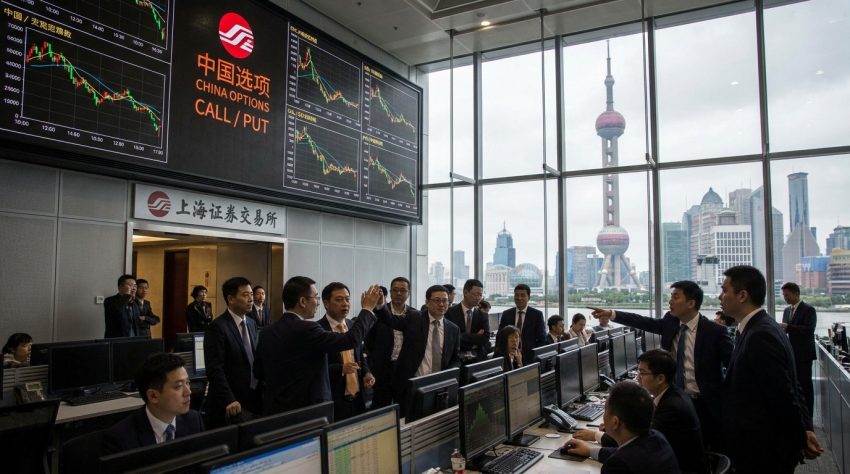
Options trading in China has developed from a relatively narrow institutional market into a larger derivatives market covering equity ETFs, stock indices and commodities. Domestic traders can find standardized option contracts on several regulated exchanges, including the Shanghai Stock Exchange, Shenzhen Stock Exchange and China Financial Futures Exchange.
The structure is different from the US market. A trader looking for calls and puts on hundreds of individual companies will not find an equivalent menu on mainland exchanges. Chinese equity options activity is concentrated heavily around ETFs and broad market indices. Commodity options add another substantial part of the market through China’s futures exchanges.
For investors with basic options knowledge, this creates a fairly familiar trading framework but with Chinese contract specifications, trading hours, margin rules, suitability requirements and exercise procedures.
It also makes terminology important. Regulated exchange traded options in mainland China should not be confused with offshore binary options or other short duration products marketed online. The China Securities Regulatory Commission regulates and supervises standardized options contracts within its mandate, including their listing, trading, settlement and delivery.
For traders considering options trading in China, the first task is therefore deciding which market and underlying asset they actually want to trade. Strategy comes after contract structure.
How the Options Market in China Is Structured
China does not have one single options venue.
Equity related ETF options are traded on the Shanghai and Shenzhen stock exchanges. Stock index options are traded through the China Financial Futures Exchange, commonly known as CFFEX. Commodity options are available through futures exchanges including the Shanghai Futures Exchange, Zhengzhou Commodity Exchange and Dalian Commodity Exchange.
This separation matters because the contracts do not behave identically.
An ETF option is linked to an exchange traded fund and can involve physical delivery of the underlying ETF. An index option is linked to the value of an index rather than a security that can be transferred directly. Commodity options normally relate to futures contracts and require knowledge of the underlying futures market.
China’s regulated option market has expanded gradually rather than opening every contract type at once.
The Shanghai Stock Exchange launched SSE 50 ETF options in 2015. CSI 300 ETF options followed in 2019 and CSI 500 ETF options were added later. The current Shanghai Stock Exchange derivatives section publishes contract specifications for its ETF options, including calls, puts, strikes, expiry months and margin calculations.
CFFEX provides a separate group of financial index derivatives. Its current product menu includes CSI 300 Index Options, CSI 1000 Index Options and SSE 50 Index Options alongside related index futures.
The result is a market where traders can express views on large capitalization stocks, mid and smaller companies, technology heavy sectors and broad Chinese equity benchmarks without needing an option on each individual company.
Is Options Trading Legal in China?
Yes. Standardized options trading through approved Chinese exchanges is a regulated financial activity.
The CSRC’s stated responsibilities include supervising futures contracts and standardized option contracts on the domestic market. It also supervises exchanges and derivatives businesses conducted by securities, futures and fund management institutions.
That does not mean every website offering options to people in China is part of the regulated domestic market.
The distinction is fairly basic. A contract listed on an approved Chinese securities or futures exchange operates within an established trading, clearing and regulatory framework. A foreign website accepting deposits from Chinese residents may fall into a completely different legal category.
Traders should therefore verify the venue, intermediary and actual legal entity rather than relying on the word “options” in a platform’s marketing.
China’s derivatives rules place substantial weight on organized trading venues and approved intermediaries. Earlier regulations governing futures trading defined option contracts as standardized contracts prepared by approved futures trading venues and placed futures and options activity within a centralized regulatory structure. The regulatory framework has continued to develop since then. The CSRC’s regulatory information remains the primary place to check national level securities and derivatives rules.
For an ordinary trader, the practical point is simpler. If the goal is to trade mainland Chinese options, using an authorized securities or futures institution connected to an approved domestic exchange is very different from transferring money to an offshore platform that happens to offer contracts referencing Chinese assets.
What Options Can Traders Trade in China?
Chinese options can be divided broadly into ETF options, index options and commodity options.
ETF Options
The Shanghai Stock Exchange provides several equity ETF contracts.
Its SSE 50 ETF options use the ChinaAMC SSE 50 ETF as their underlying asset. Both calls and puts are available. The standard contract size is 10,000 ETF units and the exchange lists contracts across the current month, next month and two following quarterly months.
CSI 300 ETF options on the SSE follow the Huatai PineBridge CSI 300 ETF, ticker 510300. The contract structure is similar, with calls and puts, a 10,000 unit contract size and several expiry months.
The SSE also lists CSI 500 ETF options based on the China Southern CSI 500 ETF. These give traders exposure to a different section of the Chinese equity market from the larger companies represented heavily in the SSE 50.
Shenzhen has developed its own ETF options market, including contracts tied to the CSI 300, CSI 500 and ChiNext related ETFs. ChiNext exposure is particularly interesting for traders who want a contract influenced more heavily by growth oriented Chinese companies rather than the large financial and state owned businesses common in older mainland indices.
An ETF option trader is therefore trading the price of the underlying fund, not directly trading an index number.
Stock Index Options
CFFEX provides stock index options.
The China Financial Futures Exchange currently displays CSI 300, CSI 1000 and SSE 50 index option products.
The CSI 300 represents large and medium sized A shares across Shanghai and Shenzhen. The SSE 50 is concentrated in large Shanghai listed companies. The CSI 1000 reaches further down the capitalization range and behaves differently during periods when smaller companies outperform or underperform large caps.
This gives traders several ways to express a market view.
A trader expecting large blue chip companies to remain relatively stable while smaller shares weaken could construct exposure around different indices rather than treating the Chinese equity market as one homogeneous trade.
Commodity Options
China also has a large commodity derivatives market.
Commodity options may cover agricultural products, metals, energy related contracts and industrial materials. These contracts are more relevant to traders familiar with futures because their underlying instrument is often a futures contract.
A commodity option position can behave very differently from an equity ETF option. Seasonal supply, inventory data, weather, industrial demand and government policy can have greater influence than company earnings or equity valuations.
A trader moving between these markets needs to understand the underlying asset first. Knowing Black Scholes terminology does not tell you why sugar, copper or an equity ETF moved 4% this week.
How Chinese ETF Options Work
The basic mechanics will look familiar to anyone who has traded standard calls and puts elsewhere.
A call gives the holder the right associated with buying the underlying asset at the strike price under the contract terms. A put gives the holder the corresponding right to sell.
The option buyer pays a premium. The seller receives the premium while accepting the obligations created by the contract.
On the Shanghai Stock Exchange, the major ETF options described by the exchange use European style exercise. That means exercise occurs at expiration rather than at any time before expiration. The contracts are normally physically delivered unless exchange rules provide otherwise.
For the SSE 50 ETF option, expiry is normally the fourth Wednesday of the expiration month, subject to holiday adjustments. Standard trading takes place during the mainland securities market’s morning and afternoon sessions. The exchange states trading hours of 9:15 to 9:25 for the opening auction, 9:30 to 11:30, then 13:00 to 15:00, with a closing auction near the end of the afternoon session.
Contract size deserves attention.
If an option quote appears cheap, multiplying the quoted premium by the contract unit can produce a considerably larger actual cash exposure. On the SSE contracts described above, the multiplier is tied to 10,000 ETF units.
Suppose an option premium is RMB 0.1200.
At 10,000 units, one contract represents RMB 1,200 in premium before applicable commissions and charges.
A trader who reads 0.1200 as the full position cost rather than the per unit price has misunderstood the contract by several orders of magnitude. It is a rather expensive decimal point.
Opening an Options Trading Account in China
Access to Chinese exchange traded options is subject to investor suitability controls.
Options are not treated in the same manner as opening a basic cash equity account and purchasing ordinary A shares. Securities and futures institutions assess whether customers meet the relevant requirements for the products they want to trade.
Requirements can involve account assets, previous trading experience, knowledge assessments, risk tolerance and completion of required investor education procedures. The applicable conditions can vary according to the market, investor category and contract.
Traders should confirm the current rules with an authorized Chinese securities or futures company rather than relying on an old account opening article. China has changed access rules in several parts of its capital market over time.
The point of suitability rules is not cosmetic. Options permit leverage, option selling creates potentially large liabilities, and an apparently small premium can behave very differently from a stock position.
A trader should also establish which permissions have actually been granted once the account is active. Permission to buy options does not necessarily imply unrestricted permission to sell uncovered options, trade futures related contracts or use every strategy available on another exchange.
Option Pricing in the Chinese Market
The same basic pricing forces found in other options markets operate in China.
The price of the underlying asset matters, as does the strike, time remaining until expiry, expected volatility, interest rates and the contract’s other terms.
Intrinsic value is the part of an option’s value that would exist based on the relationship between the strike and underlying price. Time value reflects the possibility that the market moves further before expiration.
An out of the money option can therefore have no intrinsic value and still trade at a material premium.
Delta and Directional Exposure
Delta estimates how much an option’s price may change for a small change in the underlying, with other factors held constant.
Calls generally have positive delta and puts negative delta from the buyer’s perspective.
A deep in the money call can behave more like the underlying ETF because its delta may approach one. A far out of the money call may have a low delta and respond much less to modest price changes.
This has practical consequences for Chinese index and ETF traders.
Buying a very cheap call because the CSI 300 ETF looks bullish does not guarantee much participation in a modest rally. If the option is far out of the money and expiry is near, the ETF can rise while the option still performs badly.
Gamma and Fast Changing Delta
Gamma describes how rapidly delta changes as the underlying price moves.
It becomes especially relevant near expiry and around the strike price. Short dated at the money options may react sharply to relatively modest changes in the underlying.
This can make them attractive to short term traders. It also makes risk harder to control.
A position that appears to have moderate directional exposure in the morning can carry substantially different exposure after a large afternoon move.
Theta and Time Decay
Theta represents the erosion of option value associated with the passage of time, assuming other variables remain constant.
Option buyers pay for time. Option sellers collect premium partly in exchange for taking the other side of that decay.
This is why being correct about market direction is not enough.
A trader can expect the SSE 50 ETF to rise, buy a call and still lose money because the move arrives too late, is too small or is accompanied by declining implied volatility.
Short dated contracts make this problem particularly visible. The clock does not care about the trader’s thesis.
Vega and Implied Volatility
Vega measures sensitivity to changes in implied volatility.
Chinese equity options can reprice considerably when traders expect greater market movement. Policy announcements, economic data, changes in risk appetite and sharp index movements can all affect the volatility being priced into options.
Buying options after implied volatility has already risen can produce poor results even when the trader gets the subsequent direction roughly right.
The reverse can occur for sellers. Collecting rich premium may look attractive, but that premium may be high because the market is assigning a meaningful probability to a large move.
Options Trading Strategies in China
The appropriate strategy depends on the trader’s market view, volatility expectation, time horizon and permitted account activity.
Buying Calls and Puts
Long calls and puts are the most straightforward starting point.
A bullish trader can buy a call on an eligible ETF or index. A bearish trader can buy a put. The maximum loss for a conventional purchased option is normally the premium paid, making the initial monetary risk easier to define than an uncovered short option.
The harder part is selecting the strike and expiry.
Buying the cheapest available contract often produces a low probability position. A far out of the money option can expire worthless even after the underlying moves in the expected direction.
Paying more for an option closer to the money gives the trader greater directional sensitivity but increases capital at risk.
Covered Calls
Investors holding an underlying ETF may sell calls against their holdings where permitted and operationally supported.
The premium provides income, but the position exchanges part of the upside for that premium. If the ETF rises through the strike and remains there at expiry, the call obligation affects what happens to the underlying position.
A covered call should not be treated as free income. The investor is selling part of the future payoff distribution.
This matters in Chinese equity markets because powerful rallies can develop quickly after policy changes or sharp changes in sentiment. A covered call can outperform the unhedged ETF in flat markets and badly trail it during a sudden rally.
Protective Puts
A put can be used as portfolio insurance.
An investor holding an ETF or a portfolio with similar market exposure may buy puts to reduce losses during a substantial decline.
The cost is the premium.
If the market remains calm or rises, repeated put purchases can reduce portfolio returns. The question is therefore not whether puts provide protection. They do. The harder question is whether the protection is attractively priced relative to the risk being hedged.
Vertical Spreads
Call spreads and put spreads can reduce premium expenditure by combining long and short options at different strikes.
A bullish call spread, for example, buys one call and sells another call with a higher strike and the same expiry.
The short call helps pay for the long call, reducing initial cost. In exchange, maximum upside becomes capped.
This can suit a trader who has a directional target rather than expecting an unlimited move.
Spreads also make volatility assumptions important. The trader is not only forecasting whether the market rises or falls but where it might finish relative to two strike prices.
Liquidity, Trading Costs and Execution
Options should not be judged only by whether a contract exists.
Liquidity can differ substantially between strikes and expiries. Near dated, near the money contracts on heavily followed underlyings tend to attract more attention than distant contracts, but traders should inspect actual order books rather than assume liquidity.
A wide bid and ask spread creates a real trading cost.
If an option is quoted at RMB 0.1000 bid and RMB 0.1100 ask, a market buy followed immediately by a market sale produces a loss before the underlying market has moved.
Limit orders can help control execution price, although they introduce the risk that the trade is not filled.
Exchange fees are another component. The Shanghai Stock Exchange fee schedule currently states a handling fee of CNY 1.3 per contract for options with ETFs as the underlying and CNY 3 per contract for options with stocks as the underlying, with certain exchange level exemptions described in the schedule. Broker commissions and other charges may sit on top of exchange fees.
A strategy that produces a small theoretical edge can disappear once spread costs, fees and imperfect execution are included.
Managing Risk When Trading Chinese Options
Long option buyers can lose 100% of the premium. Option sellers can face much larger losses.
Those two facts should determine position size before any discussion of indicators.
A trader buying RMB 5,000 of calls should be comfortable with the possibility that the position becomes worth almost nothing. The fact that the ETF itself is unlikely to fall to zero is irrelevant. An expiring option does not need the underlying to collapse for its premium to disappear.
Short option positions require even greater care.
The margin held against a short position is not the maximum possible loss. Margin is collateral calculated under exchange and broker rules. A violent market move can increase the required margin while simultaneously creating trading losses.
The Shanghai Stock Exchange publishes minimum initial and maintenance margin formulas for short ETF options as part of its contract specifications. Those calculations consider factors such as the option settlement price, underlying price and strike.
Traders also need to think in portfolio terms.
Two positions that look separate can carry nearly identical exposure. A long call on a CSI 300 ETF and another bullish position in a large cap Chinese index can both lose from the same market decline.
Ten trades are not diversified if all ten require Chinese equities to rise.
Expiration creates another form of risk. Traders holding contracts close to expiry should understand exercise, settlement and delivery procedures before entering them. Waiting until the final afternoon to learn whether an option is physically delivered is an avoidable problem.
Options Trading in China for Foreign Investors
Foreign access to mainland Chinese derivatives has expanded, but it is not identical to domestic retail access.
Qualified Foreign Investors, commonly referred to as QFIIs, operate under a dedicated access framework. The Shanghai Stock Exchange’s current QFII investment scope states that approved exchange listed options are within the eligible investment scope subject to applicable restrictions.
The rules have been broadened in stages.
Commodity futures, commodity options and stock index options became accessible to Qualified Foreign Investors from November 1, 2021 under the stated framework. Stock index option trading is restricted to hedging purposes for these investors.
A further change took effect on October 9, 2025, when ETF options became accessible to Qualified Foreign Investors for hedging purposes.
This is an important distinction for an overseas fund manager reading about China’s domestic options market.
The fact that a Chinese retail or institutional investor can trade a product domestically does not automatically mean an overseas investor has equivalent access or can use it for unrestricted speculative trading.
Foreign institutions need to work through the applicable QFII structure, custodians and approved intermediaries and comply with the permitted purpose of the trade.
Swing Trading Options in China
Options can also be used for swing trades lasting several days or weeks rather than intraday speculation.
The attraction is leverage. A trader with a medium term view on the CSI 300, SSE 50 or another option linked benchmark can obtain directional exposure without paying the full value of the underlying ETF.
The cost is that the position becomes dependent on more than direction.
A swing trader holding an ETF only needs to worry primarily about what the ETF price does. An options swing trader must also account for time decay, volatility and strike selection.
A useful starting point is therefore to identify the intended market move before choosing the option contract.
A trader expecting a moderate rise over ten trading days may require a different strike and expiry from somebody expecting a sharp two day breakout.
Readers researching the broader trading style can also use the SwingTrading.com index page, which covers swing trading across stocks, forex and other markets. Its material explains the common approach of holding positions across several sessions and using technical and fundamental analysis to identify medium term price moves.
For options traders, the important adjustment is that a technically correct swing setup can still produce a poor option trade if the contract is too expensive, too far out of the money or too close to expiry.
The setup and the instrument need to agree.
What Traders Should Know Before Trading Options in China
Options trading in China is a regulated and increasingly broad part of the mainland derivatives market. Traders can access ETF options on securities exchanges, stock index options through CFFEX and a much wider group of commodity related contracts through China’s futures exchanges.
The basic principles remain familiar: calls, puts, strikes, premiums, expiration, delta, theta and volatility. The Chinese market adds its own contract sizes, trading sessions, exercise rules, suitability controls and access restrictions.
For domestic traders, understanding those contract specifications is just as important as finding a directional trade. For foreign institutions, the question of permitted access and hedging restrictions comes before strategy selection.
Options are useful because they allow traders to separate direction, time and volatility in ways that ordinary shares cannot. That same flexibility makes them less forgiving when a trader misunderstands the contract.
Before placing an order, check the exchange specification, calculate the actual contract exposure, examine liquidity and know what happens at expiry. In options trading, being right about the market is only part of the job.