
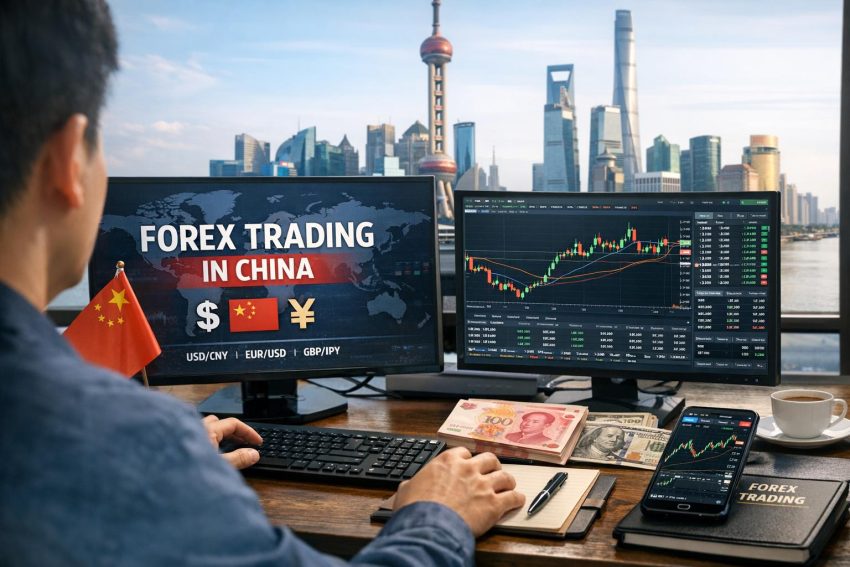
Forex trading, short for foreign-exchange trading, involves buying one currency and selling another. Traders use currency pairs such as EUR/USD, USD/JPY, GBP/USD, and USD/CNH to track the relative value of two currencies. The market operates through banks, financial institutions, corporations, funds, and retail trading providers during the business week.
People who want to learn forex trading in China need to study more than price charts and economic reports. Mainland China applies foreign-exchange controls, cross-border payment rules, and restrictions on financial services. A trading platform may be licensed abroad yet lack permission to market margin forex products to residents of mainland China.
Learning about currencies is not the same as opening a live margin trading account. Reading central-bank reports, following exchange rates, testing ideas with historical data, and using a demonstration platform are educational activities. Depositing money with an overseas broker raises separate legal, regulatory, payment, tax, and consumer-protection questions.
Rules and enforcement practices may change. Before depositing funds, a mainland Chinese resident should check current notices from the State Administration of Foreign Exchange, the People’s Bank of China, the China Securities Regulatory Commission, and an authorised bank. Advice from a qualified Chinese lawyer or tax adviser may also be appropriate where cross-border transactions are involved.
How the forex market works
A currency pair states the value of one currency in relation to another. In EUR/USD, the euro is the base currency and the US dollar is the quote currency. A price of 1.1000 means that one euro is valued at 1.10 US dollars. If the rate rises to 1.1050, the euro has gained against the dollar. If it falls to 1.0950, the euro has weakened against the dollar.
A trader who expects the base currency to rise may open a long position. A trader who expects it to fall may open a short position. Profit or loss depends on the difference between the opening and closing prices, multiplied by the position size. Trading fees, spreads, overnight financing, and currency-conversion charges must then be deducted.
Retail forex is generally quoted with two prices:
| Term | Meaning |
|---|---|
| Bid | The price at which the platform will buy the base currency from the trader. |
| Ask | The price at which the platform will sell the base currency to the trader. |
| Spread | The difference between the bid and ask prices. |
| Pip | A standard unit used to measure a change in a currency quote. |
| Lot | A unit used to describe position size. |
| Margin | Funds set aside to support an open position. |
On many major currency pairs, one pip is the fourth decimal place. A move from 1.1000 to 1.1001 is one pip. Currency pairs involving the Japanese yen often use the second decimal place as the usual pip measurement. Trading platforms may also display fractional pips.
The spread is a direct trading cost. If EUR/USD shows a bid of 1.1000 and an ask of 1.1002, the spread is two pips. A newly opened long trade begins with a small unrealised loss because it was opened at the higher ask price but could immediately be closed only at the lower bid price.
Spot currency, CFDs, and margin forex
The term spot forex can cause confusion. In the institutional market, a spot currency transaction normally involves an agreement to exchange two currencies with settlement under accepted market conventions. A retail online platform may instead provide a rolling contract or contract for difference. No ordinary delivery of the purchased currency may occur.
A contract for difference, usually called a CFD, settles the price difference between the opening and closing of a position. The trader does not own the underlying currency. The platform acts as counterparty or sends the order to another financial institution, depending on its execution model.
Many retail products provide geared exposure. A relatively small margin balance can support a much larger market position. At a 20:1 ratio, a margin deposit of 1,000 currency units may support exposure worth 20,000 units. A 1% move in the market would then equal about 20% of the original margin, before trading costs.
Geared exposure can magnify gains, but it magnifies losses at the same rate. It also makes ordinary market movement more dangerous. Currency prices do not need to collapse for a trader to lose a large share of an account. A short, sharp move can be enough.
Forex speculation should not be confused with exchanging money for travel, tuition, medical treatment, or approved business payments. A customer purchasing foreign currency from a bank for a permitted purpose is using a regulated banking service. Opening a margin contract to profit from price movement is a different activity with different rules.
Forex regulation in mainland China
Mainland China maintains a managed foreign-exchange system. The State Administration of Foreign Exchange, commonly known as SAFE, administers many rules concerning currency conversion and cross-border fund movement. The People’s Bank of China oversees monetary policy and plays a central role in renminbi exchange-rate arrangements. Other authorities may become relevant depending on whether a product is treated as a security, derivative, banking service, or illegal investment activity.
Ordinary retail customers do not have an unrestricted right to open margin forex accounts with any online provider they choose. A website written in Chinese, a local customer-service number, or the ability to display balances in renminbi does not prove that a platform may legally serve mainland residents.
An overseas licence also answers only part of the question. It may show that a company has permission to conduct certain business in the country that issued the licence. It does not automatically authorise that company to solicit or accept clients in mainland China. Nor does it guarantee that a mainland customer can use the foreign regulator’s complaint or compensation process.
Three separate questions should be asked:
- Is the company genuinely licensed by the authority it names?
- Does its licence cover margin foreign-exchange or CFD services for retail customers?
- May it lawfully provide those services to a person residing in mainland China?
A positive answer to the first question does not settle the other two. This distinction is often missed in online broker advertising.
Personal foreign-exchange allowances
China permits eligible individuals to purchase foreign currency through authorised banks within applicable rules and annual quotas. That allowance is connected to permitted personal uses and reporting requirements. It should not be treated as automatic permission to fund speculative offshore trading.
A bank may ask about the purpose of a transfer, request supporting documents, or reject a payment that does not meet its compliance duties. Giving false payment descriptions or breaking transfers into smaller amounts to avoid review can create legal and banking problems. Using relatives, friends, private exchangers, cryptocurrency transfers, or unrelated companies does not remove those risks.
A broker or agent may claim that it has a “special channel” for deposits. That statement calls for caution, not admiration. Informal payment routes can expose the customer to fraud, frozen bank accounts, money-laundering investigations, and difficulty proving where the funds went.
Enforcement and access can change
Website availability is not evidence of legal approval. A trading site may be accessible for a period and later become unavailable. Payment processors may stop accepting deposits, banks may block transactions, and applications may disappear from app stores. A trader can then face difficulty closing positions or requesting a withdrawal.
Regulatory notices should be checked close to the date of any proposed transaction. Old forum posts and cached broker pages are poor substitutes for current official guidance. Financial rules are not improved by guesswork.
CNY, CNH, and the renminbi exchange rate
Learners in China should become familiar with the difference between CNY and CNH. Both refer to the renminbi, but they trade in different settings.
CNY generally refers to the onshore renminbi market in mainland China. It operates within domestic monetary and foreign-exchange arrangements. CNH generally refers to renminbi traded outside mainland China, including financial centres such as Hong Kong.
The two rates are closely related, but they can diverge. Offshore liquidity, foreign investor demand, policy expectations, and cross-border funding conditions can cause USD/CNH to trade at a different level from USD/CNY. The gap may narrow through approved market activity, though regulatory boundaries affect how freely funds can move between the two markets.
The renminbi does not trade in the same manner as a fully floating major currency. The People’s Bank of China publishes a daily reference rate for the onshore market, and trading occurs within an authorised band around that rate. Policy action, state-bank activity, liquidity management, and administrative measures can affect market conditions.
Anyone studying USD/CNH should avoid treating it as a plain copy of EUR/USD or GBP/USD. Policy communication and onshore-offshore funding conditions may have a greater role. Price gaps can also occur after holidays or during periods when one market is open and another is closed.
Economic factors that move currencies
Exchange rates reflect expectations about interest rates, inflation, economic activity, trade, capital movement, and political risk. Currency prices often react to what traders expected before a report, rather than whether the report looks good or bad in isolation.
Suppose an inflation report comes in above the prior reading. A beginner may assume that the currency must rise. The market may instead fall if traders expected an even higher number, or if they believe the increase will weaken household spending. Context matters.
Interest rates and central-bank policy
Interest-rate expectations are a major influence on currency valuation. Higher rates may increase demand for a currency because deposits and bonds denominated in that currency can offer better returns. Yet higher rates may also slow credit growth and economic activity. Traders therefore assess both the rate level and the reasons behind it.
Central banks communicate through policy statements, press conferences, meeting records, and speeches. The People’s Bank of China, US Federal Reserve, European Central Bank, Bank of Japan, and Bank of England all affect heavily traded currency pairs.
Markets tend to price expected policy changes before an official announcement. If a rate cut has been widely anticipated, the currency may show little reaction when the cut occurs. A larger-than-expected cut or a change in guidance may produce a stronger move.
Inflation and employment
Inflation reports influence forecasts for monetary policy. Persistent price growth may lead traders to expect tighter policy, while weak inflation may increase expectations of rate reductions. Employment reports provide clues about wages, household income, consumer demand, and business conditions.
Data releases can create fast movement and wider spreads. An order displayed at one price may execute at another if quotes change before it reaches the market. This difference is called slippage.
Chinese trade and economic data
China is a major exporter, importer, manufacturing centre, and consumer of commodities. Reports on industrial production, retail sales, property activity, credit growth, exports, imports, and purchasing managers’ surveys can affect renminbi expectations and currencies linked to Asian trade.
The Australian dollar often responds to changes in views about Chinese demand because Australia exports raw materials to China. The reaction is not fixed, however. Commodity prices, Australian interest-rate forecasts, and broad US dollar movement can outweigh the China-related effect.
Reading forex charts
A forex chart displays exchange-rate movement over time. Line charts provide a simple closing-price view, while bar and candlestick charts show the open, high, low, and close for each period. Candlestick charts are widely used because they present that data in a compact form.
A daily candle covers one trading day under the data provider’s time convention. A four-hour candle covers four hours, and a five-minute candle covers five minutes. Brokers may use different server times, so daily candles can vary slightly between platforms even though they describe the same market.
Trend, range, support, and resistance
An upward trend generally shows rising swing highs and rising swing lows. A downward trend tends to show falling highs and falling lows. A range forms when price repeatedly trades between an upper and lower area without establishing a sustained direction.
Support is an area where buying has previously appeared. Resistance is an area where selling has previously appeared. They are better treated as zones than exact prices. Market orders, stop orders, option positions, and changing expectations can cause price to pass through a prior level before reversing.
A previous reaction does not guarantee another reaction. Support can fail, and former support can later act as resistance. Charts describe behaviour; they do not impose rules on future prices.
Moving averages and momentum indicators
A moving average smooths past prices over a chosen period. Traders may use it to assess direction or compare short-term and long-term movement. It reacts after prices move, so it should not be mistaken for a leading forecast.
Momentum indicators such as the relative strength index measure the speed or strength of recent price changes. Terms such as overbought and oversold do not mean that a reversal must occur. A strong trend can remain overbought or oversold for a long period.
Loading a chart with ten indicators rarely improves analysis. Many indicators derive from the same price data and may repeat the same message in different colours. One or two well-tested tools are easier to review.
Fundamental and technical analysis
Technical analysis studies price behaviour, volatility, chart levels, and market timing. Fundamental analysis considers economic policy, data, valuation, trade, and political events. The two approaches answer different questions.
Fundamental work may help a trader form a medium-term view. Technical work may help define an entry price, invalidation point, and exit plan. Combining them can be useful, but only if the rules remain clear. A trader should not use a chart argument to enter a trade and then switch to an economic argument to avoid closing a losing position.
A practical research note might state that interest-rate expectations support one currency, price is above a longer-term moving average, and a prior resistance area has become support. It should also state what would show that the idea was wrong. Without an invalidation condition, an opinion can linger long after the evidence changes.
Order types and execution
A market order requests execution at the best available price. It prioritises execution rather than price certainty. During calm trading, the difference between the displayed and filled price may be small. During a major announcement or market gap, it may be much larger.
A limit order sets the worst acceptable price. A buy limit is normally placed below the current market, while a sell limit is placed above it. The order may not be filled if price does not reach the selected level or if insufficient volume is available.
A stop entry order becomes active after price reaches a chosen level. Traders often use it to enter after a breakout. A stop-loss order is intended to close a position once the market reaches a loss threshold.
Stop-loss orders reduce risk under ordinary conditions but do not guarantee the final execution price. Weekend gaps, sudden policy announcements, technical failures, and thin liquidity can produce a fill beyond the chosen stop. Some regulated providers offer guaranteed stops for a fee, subject to their contract terms.
A take-profit order closes a position at a planned gain. Traders sometimes place both a stop-loss and take-profit at the time of entry. This can reduce impulsive decisions, though the levels still need a defensible basis.
Calculating trade size and risk
Position sizing connects the trading idea to the amount of money at risk. Choosing the maximum size permitted by a platform is not a risk method. The calculation should begin with the amount the trader can afford to lose if the stop is reached.
Assume a demonstration account contains 50,000 yuan and the learner sets a hypothetical trade risk of 250 yuan. If the planned stop is 50 pips away, the position should have a pip value of about 5 yuan. Transaction costs and possible slippage should also be allowed for.
The basic relationship is:
Amount at risk ÷ stop distance = acceptable value per pip
The platform’s contract size and account currency must then be used to convert the pip value into a position size. This calculation varies across pairs. A pip in USD/JPY does not have exactly the same account-currency value as a pip in EUR/USD.
A smaller stop does not automatically create a safer trade. If the stop sits inside normal market movement, it may be triggered frequently. The stop should reflect the point at which the trading idea no longer holds, and the position size should then be reduced to keep the monetary risk within the plan.
Risk-to-reward ratios
A risk-to-reward ratio compares the planned loss with the planned gain. If a trade risks 100 yuan to target 200 yuan, the ratio is 1:2. That ratio alone says little about whether the method works. The probability of reaching either level and the effect of costs also matter.
A strategy with a low win rate can make money if average gains exceed average losses by enough. A strategy with many winning trades can still lose money if occasional losses are very large. Traders should assess expectancy rather than focus only on the percentage of winners.
A simplified expectancy formula is:
(Win rate × average gain) − (loss rate × average loss)
The result should be calculated after spreads, commissions, financing, and slippage. A method that appears profitable before costs may perform poorly after them.
Margin calls and forced liquidation
Margin is the amount reserved by a provider to support an open position. If losses reduce account equity below the provider’s threshold, the platform may issue a margin warning or automatically close positions.
Forced liquidation does not guarantee that the account will be closed at the displayed threshold. Fast markets can move through available prices. Whether a customer can owe more than the deposited balance depends on the provider, product, jurisdiction, and account agreement.
Margin rules can also change during elections, central-bank meetings, holidays, or periods of market stress. A provider may raise margin requirements, which means the same position requires more account equity. A trader operating close to the minimum may then face forced closure without any large change in the currency price.
Maintaining spare account equity can reduce this risk, but it does not make margin trading safe. Exposure should remain small enough that an adverse move does not threaten household finances.
Building a forex study plan
A sensible study plan begins with terminology, calculations, and regulation. Trading signals should come later. Someone who cannot calculate pip value, margin use, or the cost of holding a position overnight is not ready to assess a trading strategy.
During the opening stage, study currency quotations, order types, contract terms, and economic calendars. Follow one or two major pairs rather than trying to monitor every available instrument. EUR/USD and USD/JPY often provide ample material for learning market behaviour. USD/CNH is useful for studying renminbi policy and offshore pricing, though it has its own trading characteristics.
The next stage can focus on one analytical method. A learner might classify the daily trend, mark prior weekly price zones, and observe how the pair behaves around scheduled economic reports. Each decision should be recorded before the result is known.
Only after a clear process has been written should it be tested on a demonstration account. The purpose of demo practice is not to produce an impressive virtual balance. It is to check whether the rules can be followed and whether the method has acceptable results after realistic costs.
Using a demonstration account
A demonstration account provides virtual funds and simulated execution. It allows learners to practise opening and closing positions, setting stops, changing order size, and reading account metrics without risking money.
Demo results can be misleading if the account balance is far larger than the amount that would ever be deposited. A learner planning around 20,000 yuan should not practise with a virtual balance of 10 million yuan and oversized positions. The numbers may look cheerful, but the exercise has little value.
The demo account should use realistic position sizes, costs, and trading hours. If the proposed approach holds positions overnight, financing charges should be included. If it trades during news releases, possible slippage and wider spreads should be considered.
Simulated trading cannot reproduce the pressure of real loss. People often follow rules calmly with virtual money and abandon them once cash is involved. Demo performance should therefore be viewed as a test of mechanics and process, not proof of future profit.
Keeping a trading journal
A trading journal creates a record that can be reviewed without relying on memory. Memory tends to favour dramatic wins and forget routine losses, which is not especially helpful.
Each journal entry should state the currency pair, date, trading session, entry, stop, target, position size, planned risk, economic events, and reason for taking the trade. It should note whether the rules were followed and include the net result after costs.
Screenshots can show market conditions at entry and exit. A short written note is still useful because an image does not explain what the trader believed at the time.
Performance should be reviewed over a reasonable sample. Five trades reveal very little. A run of wins may reflect favourable market conditions, while a run of losses may occur even under a viable method. The review should separate method results from execution errors.
Backtesting without fooling yourself
Backtesting applies written rules to historical data. It can show how a method would have behaved during earlier market periods. It can also expose vague rules that cannot be applied consistently.
Historical testing has several weaknesses. Data may contain errors, omit spreads, or use prices that were not tradable. A model can also be fitted too closely to past behaviour. This is known as overfitting. Such a model may produce excellent historical results and fail promptly on new data.
To reduce that risk, rules should be tested across different periods, including trends, ranges, calm markets, and abrupt policy moves. Part of the data can be reserved for later testing rather than used to develop the method.
Forward testing applies the rules to new market data, usually through a demo account. It provides a more realistic view of timing and execution. It still cannot predict future returns, but it can expose practical issues that a spreadsheet misses.
How to assess a forex broker
Broker checks should begin with the company’s exact legal name. Brand names can be shared by several related businesses, each regulated in a different place. The account agreement should identify which company will hold the customer’s account.
The regulator’s public register should confirm the company name, licence number, address, permitted activities, and licence status. A copied logo or certificate on a broker website is not enough. Fraud sites sometimes clone the details of a genuine regulated company while using different contact details and payment accounts.
Client-money rules deserve close attention. Find out whether customer funds are held separately from the company’s operating money, what happens if the broker becomes insolvent, and whether a compensation scheme applies. Protection may differ for customers classified as professional rather than retail clients.
Read the withdrawal terms before depositing. Check identity-verification requirements, fees, processing periods, minimum withdrawal amounts, and whether funds must return through the original payment method. Bonus terms can restrict withdrawals until a high trading volume has been reached.
Execution policies should explain whether the provider acts as principal, agent, or both. They should also describe slippage, rejected orders, price sources, market closures, and the handling of platform errors.
Even a well-regulated foreign broker may lack authority to accept mainland Chinese residents. Broker quality and legal availability are separate matters.
Forex scams aimed at Chinese traders
Fraud often begins through social media, messaging applications, dating sites, investment groups, or a personal introduction. The promoter may display fabricated account profits or allow a small early withdrawal to build trust. Larger deposits are then requested.
Common warning signs include guaranteed monthly returns, pressure to deposit quickly, private payment accounts, and claims that an analyst can trade without losses. Recruitment commissions and rewards for bringing in friends may indicate a pyramid-style operation rather than genuine brokerage.
A common withdrawal fraud asks the customer to pay a tax, security deposit, account-upgrade charge, or anti-money-laundering fee before funds can be released. Paying the fee usually leads to another demand. Legitimate taxes and account charges are not normally collected through a private wallet controlled by an anonymous customer-service agent.
Do not give a broker representative remote access to a phone or computer. Do not share online-banking passwords, text-message codes, identity verification videos, or cryptocurrency wallet recovery phrases. A genuine provider does not need that access.
If fraud is suspected, stop sending money, preserve messages and transaction records, contact the bank or payment provider promptly, and report the matter to the appropriate authorities. Recovery companies should also be checked carefully; some target victims with a second advance-fee scam.
Trading costs that beginners overlook
The spread is only one part of the cost. Some accounts charge a commission based on transaction volume. Positions held after the broker’s daily cut-off may incur an overnight financing adjustment, often called a swap or rollover charge.
Financing reflects interest-rate differences, provider mark-ups, and contract rules. It can be either a debit or credit, but a favourable interest-rate difference does not guarantee a credit. The broker’s own schedule controls the amount.
Many providers apply a larger rollover charge on one weekday to account for weekend settlement. Public holidays can also alter the schedule. A position held for several weeks may accumulate material financing costs even if the currency price barely changes.
Other possible charges include inactivity fees, data fees, withdrawal fees, conversion charges, and payment-provider costs. A Chinese resident may also face exchange-rate costs when converting renminbi into the account currency and back again.
Tax and record-keeping considerations
The tax treatment of forex income depends on the product, account structure, trader’s circumstances, transaction frequency, and jurisdictions involved. An offshore account does not automatically place gains outside Chinese reporting or tax rules.
Keep account statements, trade confirmations, deposit records, withdrawal records, bank receipts, fee schedules, and correspondence. Records should show the original transaction currency and the conversion rate used for any renminbi calculation.
A broker’s annual statement may not contain every item required for Chinese tax or foreign-exchange reporting. Material or recurring activity warrants advice from a qualified professional familiar with mainland Chinese rules and cross-border financial accounts.
Record retention also helps with disputes. If a platform changes a transaction history or denies receiving a payment, independent bank records and downloaded statements may be valuable.
Setting realistic expectations
Forex trading is not a dependable replacement for employment, business income, or long-term saving. Short-term currency movement contains a large amount of uncertainty, and trading costs create a hurdle that every method must overcome.
Profit screenshots rarely show deposits, prior losses, open positions, fees, or whether the account is real. Social media content often rewards dramatic claims rather than accurate accounting. Learners should judge a method by documented results over time, not by a single winning trade.
Money needed for rent, food, education, medical care, debt payments, or family support should not be placed in a margin account. Borrowing to trade makes the risk worse because the debt remains even if the trading funds are lost.
There is no need to open a live account simply because currency markets are interesting. A person can study central-bank policy, analyse exchange-rate data, and practise financial calculations without sending money abroad. That may be the more sensible outcome where legal access is uncertain.
A responsible route for learners in China
Start by learning how currency pairs, pips, spreads, position sizes, margin, and order types work. Study CNY and CNH alongside major international pairs. Read official economic releases and central-bank statements rather than relying on anonymous chat groups.
Use historical data and a realistic demonstration account to test written rules. Record every trade, include all estimated costs, and assess results across different market conditions. Keep the method simple enough that another person could read the rules and reach roughly the same decision.
Before considering live trading, verify the legal entity, its licence, the permitted products, client-money arrangements, and whether it may serve mainland Chinese residents. Confirm that the payment method complies with Chinese foreign-exchange and banking rules. Never disguise the purpose of a transfer or use an informal channel to bypass controls.
If an authorised Chinese bank or another permitted institution offers a foreign-exchange product, read its contract, fee schedule, settlement terms, risk warnings, and withdrawal rules. A product offered through a familiar institution can still carry market risk, so authorisation should not be confused with profitability.
Learning forex trading in China is mainly an exercise in financial education, disciplined risk calculation, and regulatory care. Chart analysis has a role, but it comes after legality, account safety, and fund protection. Anyone who cannot verify those points should remain with education and simulated practice rather than place capital at risk.