
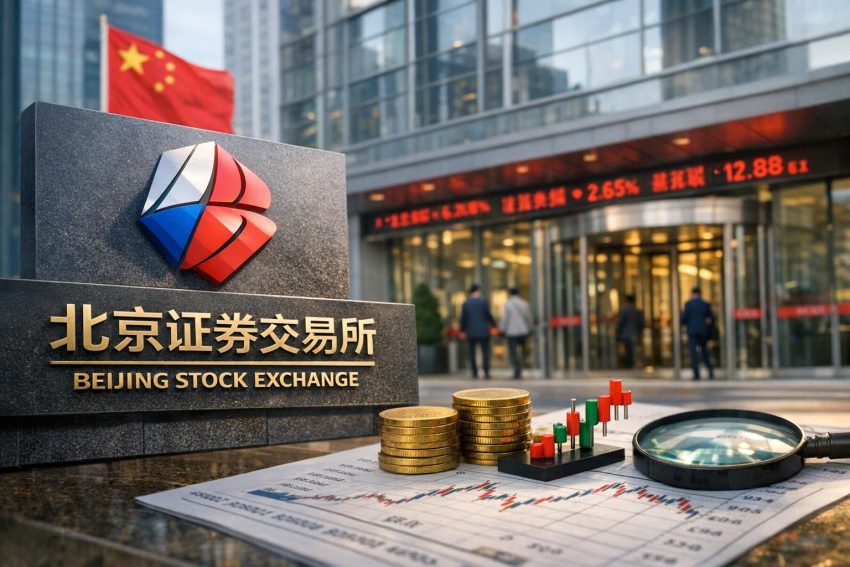
The Beijing Stock Exchange (BSE) is a mainland Chinese securities exchange focused on financing and trading shares in small and medium-sized enterprises (SMEs). It began operations on 15 November 2021 and is based in Beijing. Its listed companies are generally smaller than the corporations found on the main boards of the Shanghai Stock Exchange and Shenzhen Stock Exchange.
The BSE primarily serves established SMEs with commercial operations, formal corporate structures and an interest in public equity financing. Many issuers work in advanced manufacturing, industrial technology, software, medical equipment, new materials and other research-led industries. They tend to be beyond the start-up stage but may not yet match the size or earnings profile commonly associated with China’s larger exchanges.
The exchange forms part of China’s effort to increase direct financing for private enterprises. Chinese SMEs contribute substantially to employment, manufacturing output, exports and technological research, yet many have historically depended on bank loans, founder capital or private investment. Public share issuance gives qualifying companies another source of funding and subjects them to continuing disclosure, governance and audit rules.
Investors should not treat the BSE as a scaled-down copy of Shanghai or Shenzhen. Its trading rules, issuer profile, liquidity conditions and investor-entry requirements reflect the higher uncertainty usually associated with smaller businesses. Those features can produce attractive growth opportunities, but they also call for careful analysis of cash flow, ownership, customer concentration and market valuation.
Creation and institutional background
Chinese authorities announced the establishment of the Beijing Stock Exchange in September 2021. Trading began roughly two months later, making the BSE a relatively young exchange compared with the long-established securities markets in Shanghai and Shenzhen.
The BSE was built on the National Equities Exchange and Quotations, commonly called the NEEQ or the “New Third Board.” The NEEQ is a national share-transfer system serving smaller companies that may not be ready for a conventional exchange listing. It has historically offered a public quotation and financing venue with admission and trading arrangements suited to smaller issuers.
Before the BSE opened, the NEEQ divided companies into market tiers. The Basic Layer served a broad group of quoted businesses, while the Innovation Layer applied higher admission and disclosure conditions. A further tier, known as the Selected Layer, began operating in 2020. When the BSE commenced trading, companies from the Selected Layer formed its initial group of listed issuers under the relevant conversion arrangements.
This background explains why the BSE and NEEQ remain closely connected. The exchange was not created as a stand-alone venue detached from the existing SME share-transfer system. Instead, it provides a higher public-market tier for qualifying companies that have already gained experience with reporting, governance and share quotation.
Beijing Stock Exchange Co., Ltd. operates the market. The China Securities Regulatory Commission (CSRC) supervises it, while the exchange administers admission, disclosure and trading rules within the national regulatory framework. Public offerings use a registration-based system involving review by the exchange and registration by the CSRC.
Position within China’s multi-level capital market
China’s domestic securities structure contains several boards and trading venues serving companies at different stages of development. The Shanghai Stock Exchange includes the Main Board and the Science and Technology Innovation Board, better known as the STAR Market. The Shenzhen Stock Exchange operates its Main Board and the ChiNext market. The NEEQ sits below the formal exchange level for many smaller quoted companies, while the BSE provides an exchange venue centred on qualifying SMEs.
A simplified corporate progression may begin with private financing, followed by quotation on the NEEQ and later admission to the BSE. A successful BSE company may eventually apply to transfer to an eligible Shanghai or Shenzhen board if it meets the destination market’s standards. This progression is not automatic. Each stage requires regulatory review, adequate disclosure and compliance with the relevant financial and governance tests.
The connection between the NEEQ and BSE gives companies time to establish a public reporting history before an exchange listing. Investors can review earlier reports, financing activity and ownership changes rather than relying only on an initial public offering prospectus. That history can be useful, though prior NEEQ quotation does not remove accounting, operational or governance risk.
Transfer arrangements between the BSE and other exchanges are intended to support companies that outgrow their original market. A transfer is generally treated differently from a new initial public offering because the company already has publicly traded shares. Even so, it must satisfy the rules of the receiving board, complete the required review and obtain shareholder approval where applicable.
General comparison of mainland venues
| Market | Typical issuer profile | Common investor view |
|---|---|---|
| Shanghai Main Board | Large and established companies, including major financial, industrial and state-controlled enterprises | Greater liquidity and longer operating histories |
| STAR Market | Science, semiconductor, biotechnology and advanced technology companies | Higher research intensity and technology-related valuation risk |
| Shenzhen Main Board | Established private and state-controlled companies across many industries | Broad corporate coverage with relatively active trading |
| ChiNext | Growth-oriented and technology-led companies | Growth exposure with greater earnings and valuation uncertainty |
| Beijing Stock Exchange | Innovative SMEs, often serving industrial or technical markets | Smaller issuers, thinner liquidity and higher business concentration |
| NEEQ | Quoted smaller companies at earlier public-market stages | Lower liquidity and more restricted trading conditions |
The categories in the table are broad descriptions rather than fixed boundaries. Company size, ownership and business quality vary within every market. A smaller STAR Market issuer may resemble a larger BSE company, while a mature BSE manufacturer may have steadier finances than an early-stage technology business listed elsewhere.
Purpose of the Beijing Stock Exchange
The BSE aims to increase the availability of equity financing for SMEs. Smaller companies often encounter difficulties in bank lending because they may hold fewer physical assets, have shorter credit histories or report less predictable cash flow. A software developer or precision-parts producer may own valuable intellectual property and customer relationships without possessing much property that can serve as loan collateral.
An exchange listing allows a company to issue shares rather than relying only on debt. Equity does not require scheduled interest payments, although it dilutes existing shareholders and introduces continuing public-company obligations. Proceeds may fund production equipment, product research, hiring, acquisitions, debt repayment or working capital.
The exchange also supports industrial upgrading and domestic technology development. Many BSE issuers fit China’s policy description of specialized, sophisticated, distinctive and innovative enterprises. This classification commonly refers to companies with focused product lines, technical expertise, strong positions in narrow markets or high research expenditure.
A company does not qualify simply because it describes itself as innovative. Admission depends on measurable standards and regulatory review. The commercial value of its products, financial condition and disclosure quality still matter. Government recognition or participation in a favoured industry may help a company obtain contracts or funding, but it does not guarantee durable profits.
Relationship between the BSE and NEEQ
A company applying for a BSE listing will generally have spent the required period quoted on the NEEQ Innovation Layer. This arrangement creates a screening stage during which the business publishes reports and operates under public-market oversight before seeking admission to the exchange.
The NEEQ reporting period can reveal how management responds to disclosure deadlines, related-party dealings and scrutiny from outside shareholders. It may also show whether the company regularly meets earnings forecasts, experiences frequent auditor changes or depends on repeated private placements.
Movement from the NEEQ to the BSE requires a formal application. The applicant must satisfy rules covering operating history, market value, financial performance, public ownership, shareholder numbers, governance and lawful conduct. The company must also demonstrate that its ownership structure is clear and that disputes over controlling rights will not disrupt its operations.
A prior quotation does not mean the exchange will approve the listing. The review may raise questions about revenue recognition, customer authenticity, research expenditure, internal controls or the intended use of offering proceeds. An issuer may withdraw its application, fail the review or postpone the offering if market conditions change.
BSE listing standards
The BSE offers several admission standards rather than relying on one net-profit test. This structure reflects the varied financial profiles of SMEs. A mature manufacturer may produce steady earnings, while a research-led company may reinvest much of its revenue and report modest current profit.
The listing framework has historically provided four main financial routes. They use combinations of estimated market capitalization, net profit, return on equity, revenue, operating cash flow and research expenditure. Numerical thresholds and calculation methods can be revised, so applicants and investors should consult the exchange’s current rulebook rather than depend on an old summary.
| Route | Primary emphasis | Business profile it may suit |
|---|---|---|
| Profitability route | Market value, net profit and return on equity | An established SME with a demonstrated earnings record |
| Revenue-growth route | Market value, revenue, revenue growth and operating cash flow | A growing company converting sales into cash |
| Research-intensity route | Market value, revenue and research expenditure as a share of revenue | A technology business investing heavily in product development |
| High-value research route | Higher estimated market value and cumulative research expenditure | A research-led issuer whose current earnings may not reflect its commercial prospects |
Under the commonly cited framework, the profitability route has applied an estimated market-capitalization threshold of RMB 200 million, paired with net-profit and return-on-equity tests. The revenue-growth route has used a higher valuation threshold, average revenue requirements, a growth test and positive net cash flow from operating activities.
The research-intensity route has applied a still higher market-value threshold, a minimum level of recent revenue and a required ratio of research spending to revenue. The fourth route has focused on companies with higher estimated valuations and substantial cumulative research expenditure, even where conventional earnings tests are less suitable.
Meeting a numerical route is only part of the assessment. An applicant must also satisfy public-float, shareholder-count and governance conditions. It needs appropriate internal controls, qualified directors and senior managers, audited financial statements and a business that can continue operating as presented in its filing documents.
Public offering documents
An applicant publishes a prospectus describing its operations, financial results, ownership, competitive position and principal risks. The document normally discusses major customers and suppliers, related-party transactions, intellectual property, legal proceedings and the intended use of offering proceeds.
Directors, supervisors and senior executives bear responsibility for disclosure accuracy. The sponsoring securities firm conducts due diligence and assists with the filing. Accountants, lawyers and valuation professionals may contribute reports within their areas of responsibility.
Regulatory review should not be read as a guarantee of investment quality. Registration confirms that the offering has passed the applicable process; it does not mean the authorities predict future profitability or approve the share price. Investors remain responsible for deciding whether the valuation and risks are acceptable.
Initial public offerings and share allocation
A BSE public offering may allocate shares among eligible online investors, offline participants and strategic investors under the applicable rules. The allocation method can affect the tradable float after listing. A smaller free float may contribute to sharp price movements if demand becomes concentrated.
Strategic placements can involve investors that agree to holding periods. These arrangements may provide a stable shareholder base, though they also mean part of the issued equity cannot trade immediately. Investors should examine lock-up terms and the dates on which restricted shares become tradable.
Offer pricing deserves close attention. Smaller issuers often have fewer directly comparable public companies, making valuation less straightforward. Management forecasts may depend on new production lines, customer orders or research projects that have not yet produced steady earnings. A high offer multiple can leave little room for execution delays.
The use of proceeds should also match the issuer’s operating capacity. A company planning a large factory expansion needs enough customer demand, personnel and working capital to use the new assets productively. Building capacity is easier than filling it; industrial history has supplied plenty of reminders.
Trading hours and order arrangements
BSE shares trade in renminbi through electronic systems. The normal session follows mainland exchange hours. An opening call auction takes place before continuous trading, the market pauses for lunch, and a closing call auction determines the final price.
| Session | Typical mainland time |
|---|---|
| Opening call auction | 09:15 to 09:25 |
| Morning continuous trading | 09:30 to 11:30 |
| Afternoon continuous trading | 13:00 to 14:57 |
| Closing call auction | 14:57 to 15:00 |
Exchange holidays, technical arrangements and order-acceptance periods may alter practical dealing times. A broker may impose an earlier cut-off for certain order types, especially for investors accessing the market through an indirect channel.
For auction trades, an order commonly begins at 100 shares, with later quantities entered in single-share increments. If an investor holds a remaining position below 100 shares, exchange rules may require the residual amount to be sold in one order. Investors should confirm the current lot rules with their broker before trading.
Daily price limits
Most BSE shares are subject to a daily price limit of 30 percent above or below the previous closing price. This band is wider than the standard limit applied to many shares on the Shanghai and Shenzhen main boards.
Newly listed shares generally trade without the ordinary daily limit on their first session. Temporary suspension measures may apply when the intraday price moves by stated percentages from the opening price. Trading then resumes according to exchange procedures.
A price limit does not cap the total loss an investor can experience. A share can fall by the maximum amount across consecutive sessions, particularly after poor results, a regulatory announcement or the expiry of a major lock-up. If sell orders greatly exceed buy orders, holding a theoretically tradable share may offer little practical comfort.
Block trades and market making
The BSE permits block trading for transactions meeting the exchange’s quantity or value thresholds. Block arrangements allow large positions to change hands without placing the full order into continuous auction trading. The reported price still matters because it may indicate institutional demand or a shareholder’s willingness to sell at a discount.
Market makers may quote eligible BSE securities by providing buy and sell prices. Their presence can improve order-book continuity and reduce wide bid-ask spreads. Market making cannot remove business risk, and quotations may still become thin during periods of heavy selling or weak demand.
Investor access and suitability requirements
Mainland individual investors must satisfy suitability rules before trading BSE shares. The commonly cited standard requires at least two years of securities-trading experience and average daily securities assets of no less than RMB 500,000 during the relevant assessment period.
The asset calculation can cover qualifying cash and securities held in the investor’s account, subject to the broker’s procedures and regulatory definitions. Borrowed funds may receive different treatment. Investors should check the active rules, calculation window and account-opening process directly with a licensed securities firm.
Institutional investors, securities firms, public funds, private funds and other approved entities may also participate. Their activity can improve market depth, but institutional coverage of smaller issuers may remain lighter than coverage of large mainland companies.
Foreign access depends on the investor’s legal status, custody arrangements, broker systems and applicable cross-border programmes. Not every international brokerage account offering mainland shares will provide BSE trading. A fund or other pooled vehicle may offer indirect exposure where direct access is not available.
The higher entry threshold for individuals reflects the characteristics of the market. BSE companies may have shorter public histories, smaller floats, fewer analysts and more concentrated operations. The suitability test reduces casual participation, but it cannot determine whether a person can tolerate losses or properly assess an issuer.
Common characteristics of BSE-listed companies
Many BSE companies sell to other businesses rather than directly to consumers. Their products may include precision parts, industrial sensors, specialist machinery, electronic systems, medical devices, chemicals, materials, software or factory-automation equipment.
Such companies can hold strong positions in narrow product categories without having familiar brand names. A producer may supply a small component used in rail equipment, robotics or semiconductor manufacturing. Its commercial standing may depend more on technical certification and customer approval than on public recognition.
Customer and supplier concentration
Smaller industrial companies often depend on a short list of customers. A large customer can provide stable orders and help validate a product, but the relationship may give the buyer strong pricing power. Losing one contract can cause a sharp decline in revenue.
Supplier concentration creates a related problem. A company that relies on one source for a critical material, chip or machine part may face production delays if that supplier raises prices or suffers disruption. Investors should compare supplier dependence with inventory levels and available alternative sources.
Research and development
Research spending is common among BSE issuers. Product development, testing, engineering staff and patent applications can consume a large portion of revenue. The accounting treatment also matters because capitalized development costs affect reported profit differently from expenses recognized immediately.
Research expenditure should be assessed alongside commercial results. Patent counts alone reveal little about customer demand. More useful questions concern new-product revenue, gross margins, order conversion, customer retention and the time needed to recover development costs.
Founder control
A founder, family group or controlling shareholder often retains a large stake after listing. This can align management with long-term business performance because much of the founder’s wealth remains invested in the company.
Concentrated ownership may also weaken minority influence. Investors should review voting arrangements, related-party transactions, guarantees, loans involving major shareholders and any pledge of controlling shares. A high level of share pledging can become a problem if the market price falls and lenders demand extra collateral.
Continuing disclosure obligations
BSE-listed companies must issue annual and interim reports and publish announcements concerning material events. Depending on the facts, disclosure may cover acquisitions, disposals, litigation, financing, major contracts, changes in control, related-party dealings and regulatory action.
Regular reporting allows investors to compare management’s earlier statements with later results. A prospectus may forecast capacity growth or expanding margins, but subsequent reports show whether those plans produced revenue and cash.
Timeliness matters as much as the amount of disclosure. Repeated delays, frequent corrections or vague explanations can indicate weak financial controls. Changes of auditor, finance director or board secretary also deserve attention, particularly if several occur within a short period.
Audit and accounting review
Audited profit should be reconciled with operating cash flow. A company can report rising earnings while cash remains tied up in receivables or inventory. That gap may be normal during expansion, but persistent divergence deserves investigation.
Receivables should be reviewed by customer, age and collection history. Fast revenue growth financed by generous payment terms may look impressive until customers delay or fail to pay. Inventory growth should also have a commercial explanation, such as confirmed orders or planned production, rather than weak sales.
Investors should read the auditor’s opinion and notes rather than stopping at the income statement. Modified opinions, emphasis paragraphs, restatements and disputes over accounting treatment can materially alter the investment case.
Assessing a BSE company
Analysis usually begins with the business model. Investors need to know what the company sells, why customers buy it, how prices are set and what prevents competitors from taking the business. Technical language in a prospectus can make an ordinary component sound rather grand, so the commercial explanation matters more than labels.
Revenue quality comes next. Recurring orders from several independent customers generally provide greater visibility than one large project. Contract terms, cancellation rights, payment periods and customer concentration help show how dependable reported sales may be.
Margins should be compared across several reporting periods. Rising gross margins may indicate better products or production efficiency, but they can also reflect temporary input prices, subsidies or accounting changes. Falling margins may point to competition, customer bargaining power or an unfavourable product mix.
Cash flow provides another test. Capital expenditure, research spending and working-capital needs can absorb cash even when the income statement reports profit. Investors should estimate whether the company can finance its plans from operations or may need another share issue or more debt.
Valuation then connects business quality to the share price. Price-to-earnings ratios may suit profitable manufacturers, while price-to-sales or enterprise-value measures can help with lower-profit growth companies. No ratio works in isolation. Growth assumptions, dilution, balance-sheet strength and comparable-company differences all affect a reasonable valuation.
Benefits for listed companies
A BSE listing can provide permanent equity capital for expansion. Unlike a bank loan, share capital does not mature on a fixed date. This can suit a company investing in research or equipment that may take several years to produce returns.
Public status can raise the company’s profile among suppliers, customers and potential employees. Financial reports give business partners more data when assessing the issuer’s stability. Listed shares may also support employee incentive plans and provide a reference price for mergers or acquisitions.
Founders and early investors gain a regulated market for their holdings, though lock-up periods and selling restrictions may apply. The ability to sell does not mean a large holding can be disposed of quickly. Trading volume and disclosure duties can constrain the timing and size of sales.
Public reporting may lead to better budgeting, internal controls and board oversight. It also adds cost. Audit fees, sponsor work, investor relations, legal advice and reporting staff can represent a meaningful burden for a smaller company.
Potential benefits for investors
The BSE gives investors access to smaller Chinese companies that may be absent from major large-cap indices. Some operate in narrow industrial categories where domestic substitution, automation or rising technical standards may increase demand.
Smaller companies can grow rapidly from a modest base. A successful new product, production contract or expansion into another province may have a larger effect on an SME than on a national corporation. This sensitivity works both ways, of course; a lost contract can be equally influential.
The market may also contain issuers followed by relatively few analysts. Lower research coverage can create pricing errors when public filings are difficult to interpret or investor attention is low. It can just as easily leave weak businesses overpriced, so low coverage is not an advantage on its own.
Business and financial risks
SMEs commonly have fewer product lines and smaller financial reserves than large corporations. A production fault, customer loss or raw-material increase may materially reduce earnings. Management teams can also depend heavily on one founder or technical director.
Working-capital pressure is a recurring concern. Industrial customers may demand long payment periods, while suppliers expect faster settlement. The resulting gap can force an issuer to borrow even as reported revenue rises.
Research-led companies face product risk. Development projects may fail technical tests, miss regulatory approval or reach the market after a competitor has introduced a better product. High expenditure does not guarantee commercially useful results.
Policy support requires careful interpretation. Subsidies, tax preferences and procurement programmes may improve reported performance, but they can change. Investors should separate recurring operating profit from government grants and other non-operating income.
Liquidity and market-price risk
BSE trading volume is often lower than in widely held Shanghai or Shenzhen shares. A quoted price may represent a small transaction rather than the price available for a large order. Bid-ask spreads can widen when market activity falls.
Low liquidity can amplify price changes. A relatively small purchase may push a share upward, while one shareholder’s sale may depress it. This makes market orders risky, particularly in securities with shallow order books. Limit orders provide greater price control, though they may not execute.
The 30 percent daily band allows large one-day movements. Shares trading without the regular band after listing can move even further. Investors using short performance histories should account for the possibility that early prices reflect scarcity and speculation rather than settled valuation.
Lock-up expiries can add selling pressure. Prospectuses disclose restricted holdings and release dates, allowing investors to monitor when founders, strategic investors or pre-listing shareholders may sell. The expiry itself does not mean they will sell, but it changes the available supply.
Regulatory, legal and industry risks
Changes in securities rules, environmental standards, medical approvals, export controls or procurement practices can affect BSE issuers. The impact depends on the company’s products and customers. An industrial exporter may face different pressures from a domestic healthcare supplier.
Intellectual-property disputes can be costly for technology companies. A patent portfolio may protect a product, but it can also attract litigation from competitors. Investors should examine whether core technology is owned by the listed company, licensed from another party or connected to a founder-controlled entity.
Related-party activity deserves equal attention. Transactions with controlling shareholders can be commercially valid, yet they may transfer value away from minority owners if terms are unfavourable. Disclosure, board approval and pricing methods help investors judge the arrangement.
BSE indices and market measurement
The BSE 50 Index is a widely cited benchmark for the exchange. It tracks a group of representative and liquid BSE-listed companies under the index provider’s selection and weighting rules. The index gives investors a broad measure of market performance without relying on one issuer.
An index return does not describe every listed company. Smaller constituents outside the benchmark may behave very differently, and changes in index membership can affect fund demand. Investors comparing a share with the BSE 50 should consider industry, size, profitability and liquidity rather than using the benchmark as a direct peer.
Index funds and other investment products may broaden access over time. Their trading volume, fees, tracking accuracy and portfolio concentration remain relevant. A fund can reduce company-level exposure, but it still carries market, valuation and regulatory risk.
The BSE’s role in Chinese capital formation
The Beijing Stock Exchange adds a formal equity-financing channel for companies below the size commonly associated with China’s main boards. It links the NEEQ quotation system with exchange-level listing and offers a possible route to the STAR Market or ChiNext for companies that later qualify.
Its long-term performance will depend on issuer quality, truthful disclosure, effective supervision and dependable trading. A large count of listed companies has less value if investors cannot assess them or trade at reasonable prices. The development of research coverage, institutional participation and market making will influence how efficiently capital is allocated.
For companies, the exchange offers funding and public status in return for disclosure, governance and shareholder accountability. For investors, it provides access to innovative SMEs while exposing them to greater concentration, liquidity and execution risk than is common among large-cap shares.
A sound review of a BSE investment should combine the prospectus, later financial reports, cash-flow trends, ownership records and trading data. Exchange membership is a starting point, not an investment verdict. The quality of the business, the conduct of management and the price paid remain the deciding factors.