
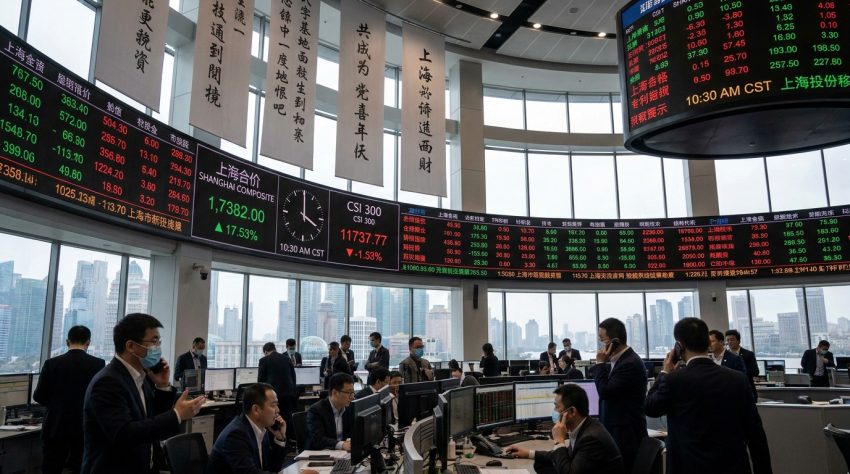
China operates one of the largest equity markets by value and trading activity, but stock trading in China differs in several practical ways from trading shares in the US, UK or much of Europe.
The distinction starts with where a company is listed. Mainland Chinese A shares trade primarily on the Shanghai Stock Exchange, Shenzhen Stock Exchange and Beijing Stock Exchange. Chinese companies can also have shares listed in Hong Kong, and some businesses maintain listings or depositary receipts outside China.
For traders, the venue matters. Trading hours, settlement rules, allowable order types, foreign investor access and daily price limits all depend on where the shares are listed.
Mainland China also uses controls that can change how a short term strategy behaves. Ordinary A shares cannot generally be bought and sold again during the same trading session. Many stocks have daily price movement limits, and some growth focused markets use wider limits than the main boards.
Investors therefore need to learn the market structure before applying a strategy developed for another country. A breakout strategy designed around US stocks does not transfer perfectly to a market where a stock can reach its permitted daily limit and stop offering normal two way liquidity.
How the Chinese Stock Market Is Structured
Mainland stock trading is divided mainly between Shanghai, Shenzhen and Beijing.
The Shanghai Stock Exchange, or SSE, contains many of China’s largest listed businesses. Its Main Board includes companies from finance, industrials, consumer industries, energy and other established sectors. Shanghai also operates the STAR Market, which was designed for technology and innovation focused companies.
The Shenzhen Stock Exchange has its own Main Board and the ChiNext Market. ChiNext has a stronger concentration of growth oriented and technology related companies. Companies trading there can therefore behave rather differently from large state linked banks, insurers or energy producers trading on the main boards.
The Beijing Stock Exchange is younger. It began trading in 2021 with an emphasis on smaller innovative businesses. Its trading rules permit wider daily share price movements than Shanghai and Shenzhen main board stocks. Chinese government information on the BSE states that its regular daily price fluctuation limit is 30%, compared with 20% for STAR and ChiNext and 10% for the Shanghai and Shenzhen main boards.
These markets sit under China’s securities regulatory structure. The China Securities Regulatory Commission oversees the securities sector at national level, while individual exchanges publish their own listing and trading rules.
For somebody researching stock trading in China, the Shanghai Composite is often the first index encountered. The Shanghai Stock Exchange describes the SSE Composite as an index covering listed A shares and B shares on the exchange. It is useful as a broad Shanghai market measure, though it is not necessarily the best benchmark for every Chinese equity strategy.
The CSI 300 is another widely followed benchmark. It covers large and medium sized A shares from Shanghai and Shenzhen. Traders looking at large mainland companies will often find it more representative than focusing on the Shanghai Composite alone.
The CSI 500 and CSI 1000 move further down the company size spectrum, while the SSE 50 focuses more heavily on large Shanghai listed businesses. ChiNext and STAR related indices provide greater exposure to technology, healthcare and other growth sectors.
This matters because saying “Chinese stocks are rising” can hide large differences between groups. Large state controlled banks may be flat while semiconductor shares rally. Small companies can weaken while major index constituents hold up. China is too large an equity market to treat every stock as one trade.
A Shares, B Shares and Other Chinese Stocks
Most discussion of mainland stock trading now centers on A shares.
The Shanghai Stock Exchange defines A shares as RMB denominated ordinary shares issued by companies incorporated and listed in mainland China and subscribed and traded in renminbi.
That is the core domestic equity market.
A shares include companies listed on Shanghai and Shenzhen’s main boards, STAR, ChiNext and shares on the Beijing Stock Exchange. Access has opened considerably to overseas investors, though not every foreign investor can buy every A share through every route.
B Shares
B shares are a smaller and older part of the Chinese equity market.
The SSE describes them as RMB denominated special shares that are subscribed and traded in foreign currencies. Shanghai B shares are traded in US dollars, while Shenzhen B shares have historically traded in Hong Kong dollars.
B shares were once one of the more obvious ways for foreign investors to obtain direct mainland equity exposure. Their relative importance declined as A share access expanded through schemes such as Stock Connect and Qualified Foreign Institutional Investor access.
A trader researching China should therefore avoid assuming that “foreign investor” automatically means B shares. In modern portfolio discussions, foreign participation in eligible A shares is far more relevant than it once was.
H Shares and Hong Kong Listings
H shares are shares in mainland Chinese companies listed in Hong Kong. They trade on the Hong Kong Stock Exchange rather than a mainland exchange.
An A share and an H share can represent equity in the same company while trading at different prices. Differences in investor base, currency, liquidity and market structure can produce a premium or discount between the two.
For an overseas investor, buying a Hong Kong listed Chinese company can be operationally easier than obtaining direct mainland access. It is not, however, the same trade.
Hong Kong has its own trading hours, settlement arrangements, price discovery process and market rules. A trader should not use “Chinese stock” and “A share” as interchangeable terms.
How Stock Trading Works in Mainland China
The mechanics of the A share market contain several differences that matter to active traders.
The revised Shanghai Stock Exchange Trading Rules took effect in July 2026. The rules state that the opening call auction runs from 9:15 to 9:25, continuous auction trading operates from 9:30 to 11:30 and from 13:00 to 14:57, and the closing call auction operates from 14:57 to 15:00.
The long midday break is therefore part of normal trading.
A trader accustomed to continuous European or US market sessions needs to account for this. News released during the break can cause the afternoon session to reopen at a substantially different price.
After Hours Trading Changed in 2026
One notable change arrived in July 2026.
The SSE’s revised rules expanded after hours fixed price trading from the STAR Market to A shares and ETFs more broadly. Under the new arrangement, qualifying securities can be traded from 15:05 to 15:30 at the day’s closing price, with orders matched according to time priority.
This is not an extension of normal continuous trading.
The execution price is fixed at the official closing price. Traders are therefore competing mainly on whether their order can be matched, rather than bidding prices against one another as they do during continuous auction trading.
The change is useful for investors who want to transact after the standard closing auction, but it does not turn the mainland market into a US style extended hours venue with continuously moving prices.
The T+1 Trading Restriction
One of the biggest differences for short term traders is the restriction on selling shares bought the same day.
Under the 2026 SSE rules, securities bought by an investor cannot normally be sold before settlement unless the instrument has been approved for turnaround trading. Ordinary A shares are not included among the instruments given intraday turnaround status.
In ordinary language, a trader cannot generally buy an A share at 10:00 and sell that newly purchased stock at 14:00 on the same trading day.
This changes day trading substantially.
A US trader might buy a breakout and close the position an hour later if momentum disappears. An A share trader buying the same setup normally carries the newly acquired shares overnight before they become eligible for sale.
That adds overnight news and gap risk to trades that might otherwise have lasted minutes.
Some funds and other instruments have different turnaround arrangements, so traders should check the rules of the actual security rather than assuming that every product listed in Shanghai operates under identical settlement restrictions.
Daily Price Limits in Chinese Stock Trading
Price limits are another major feature of mainland shares.
Under the current SSE rules, ordinary stocks covered by the standard provision generally have a daily price movement limit of 10% relative to the previous closing price. The rules contain exemptions for cases such as the first five trading days following an IPO and certain delisting or relisting events.
STAR Market shares normally use a 20% limit. The first five trading days after an IPO are not subject to that standard limit.
ChiNext also operates with a 20% daily limit under its growth market framework, while the Beijing Stock Exchange normally permits 30% movements.
The practical effect is easy to underestimate.
Suppose a normal main board share closes at RMB 20.00. Ignoring exchange rounding rules, a 10% upper limit would put the following day’s maximum around RMB 22.00, while the lower limit would sit around RMB 18.00.
A stock reaching its upper limit does not mean buyers have disappeared. Demand may remain substantial, but sellers may be unwilling or unable to provide enough shares at the permitted price.
The reverse can occur at the lower limit.
For a trader holding a stock falling rapidly, a theoretical stop loss does not guarantee execution if the market is pinned at its permitted lower level with too few buyers. The position can remain exposed into the next session.
Price limits reduce the distance a share can move during an ordinary session. They don’t remove price risk. In some situations they shift part of that risk into the following trading day.
How Residents Can Trade Stocks in China
A domestic investor normally trades mainland shares through an authorized securities company.
The SSE’s current rules state that an investor participating in exchange securities trading needs a securities account and cash account and enters into a securities trading agency agreement with a member firm.
In practical terms, this means opening a brokerage account, completing identity checks and funding the associated account before placing orders.
Access requirements can become more demanding for products or market segments considered higher risk. Trading an ordinary main board A share is not necessarily subject to the same investor suitability requirements as trading STAR Market shares, margin positions, options or other products.
Broker interfaces in China commonly provide domestic market data, financial statements, company announcements, order entry and other trading functions. Traders should still verify company disclosures through exchange sources where the information is material to the investment decision.
The difference between a broker and an exchange is worth keeping clear. The brokerage firm accepts the customer’s order and routes it into the market. The shares themselves trade under exchange rules.
Using an online application that displays a Chinese stock price does not by itself mean the application provides authorized access to the underlying A share market.
How Foreign Investors Can Buy Chinese A Shares
Foreign access to mainland stocks has changed substantially over the past decade.
One of the most relevant routes for individual international investors is Stock Connect.
Hong Kong Exchanges and Clearing’s Stock Connect information states that Shanghai Connect and Shenzhen Connect allow Hong Kong and overseas investors to trade selected mainland A shares and ETFs. Shanghai Connect started in 2014 and Shenzhen Connect followed in 2016.
Eligible Shanghai and Shenzhen main board securities can generally be accessed by overseas institutional and individual investors through the program. Access to STAR Market and ChiNext shares through Stock Connect is restricted to institutional professional investors.
That restriction is easily missed by a private trader.
Seeing a STAR or ChiNext company in a market screener does not mean an overseas retail account can necessarily buy it through Northbound Stock Connect.
Stock Connect also does not include every mainland listed security. HKEX maintains current lists of eligible securities, which investors can check before assuming a company is available.
Stock Connect Quotas
Northbound trading is subject to daily quotas.
HKEX currently states that the Northbound Daily Quota is RMB 52 billion for Shanghai Connect and RMB 52 billion for Shenzhen Connect. The quota limits net buying rather than gross turnover and is reset each trading day. Unused quota is not carried forward.
For ordinary investors this usually sits in the background, but it remains part of the market structure.
Stock Connect also uses its own order restrictions. For eligible Shanghai securities, HKEX states that Northbound traders are subject to pre trade checking, naked short selling is prohibited, and short selling is available only subject to the program’s rules.
Foreign ownership limits can also affect buying.
The SSE states that it discloses companies once aggregate overseas ownership reaches 24%. When aggregate overseas holdings reach 28% in a company, HKEX restricts further buy orders through the relevant mechanism.
A foreign trader therefore has another layer of checks that a domestic investor may not encounter.
Stock Trading Fees, Taxes and Settlement
Trading costs in China include more than the broker’s quoted commission.
For Northbound Stock Connect A shares, current HKEX documentation shows an exchange handling fee of 0.00341% of transaction value per side, a securities management fee of 0.002% per side and transfer related charges. China’s securities transaction stamp duty is currently 0.05% of transaction consideration and is imposed on the seller.
Broker commissions sit outside those figures and vary between providers.
This matters more to frequent traders than long term investors.
A strategy capturing very small price changes may look profitable before costs and mediocre afterwards. Spread, exchange charges, broker commission, taxes and slippage all consume part of the gross return.
Settlement also needs attention for overseas investors because Stock Connect settlement procedures differ from ordinary Hong Kong share transactions. HKEX states that stock positions for China Connect securities trades settle on the trading day within its clearing arrangements, with separate money settlement procedures applying through the system.
For the end investor, the more visible restriction remains that newly purchased ordinary mainland shares cannot usually be resold during the same session.
How to Analyse Chinese Stocks
The basic principles of equity analysis still apply in China.
A company earns revenue, incurs costs, holds assets, owes liabilities and either produces or consumes cash. Its share price reflects what investors are prepared to pay for the expected future benefits of owning that business.
The starting point for a long term investor is therefore not particularly exotic. Revenue growth, operating margins, cash generation, debt, return on capital and valuation all matter.
The Chinese market does, however, give policy and ownership structure greater weight in certain industries.
State Ownership and Policy Exposure
Many major Chinese listed businesses have significant state ownership.
That does not automatically make them good or bad investments. It does mean that shareholder returns may sit alongside other corporate objectives.
A state controlled bank, energy company or infrastructure business can be influenced by policy goals that a privately controlled company would not face in quite the same manner.
Government industrial policy can also affect private companies.
Changes involving property, education, technology, healthcare, renewable energy, finance or consumer policy have historically affected valuations across entire industries. Traders therefore need to monitor regulatory announcements rather than relying exclusively on earnings charts.
The CSRC and the exchange websites are primary sources for securities regulation and company disclosures. Company exchange announcements are generally preferable to social media summaries when a position depends on the precise wording of an announcement.
Valuation Still Matters
Narratives can drive a stock for a while. Cash flows eventually get a vote.
A company growing earnings at 25% a year can still be a poor investment if investors have already priced in substantially faster growth. A slow growing company can produce respectable returns when purchased at a sufficiently low valuation and supported by dividends or improving fundamentals.
Price to earnings, price to book, free cash flow measures and dividend yield can all be useful depending on the industry.
Using the same ratio for every Chinese company makes little sense. Banks are commonly assessed differently from software businesses. Commodity producers require attention to the commodity cycle. Early stage technology businesses may have little current earnings with which to calculate a meaningful earnings multiple.
Investors also need to check whether apparent low valuations reflect genuine cheapness or a market expectation of declining profits.
A stock at six times trailing earnings is not cheap if earnings are about to halve.
Trading Chinese Stocks With Technical Analysis
Shorter term traders often use price and volume rather than attempting to value the company over several years.
Support and resistance, moving averages, relative strength and volume analysis can all be applied to Chinese shares. The calculations do not change because the stock trades in Shanghai rather than London.
The market rules do change how those signals should be interpreted.
A move into a 10% daily upper limit can create a very different order book from a normal breakout. A trader also cannot assume a newly opened long position can be closed later in the session if the setup fails because of the restriction on same day resale of ordinary A shares.
Gap risk deserves more attention as a result.
If a trader buys a stock on Monday, materially negative information released after the close may cause the share to open sharply lower on Tuesday. The inability to exit the newly purchased position on Monday turns some intraday mistakes into overnight positions.
Swing trading can fit the structure better because the planned holding period is already several days or weeks.
Even then, position size matters. Wider 20% and 30% price limits on growth markets allow larger single session moves than main board shares.
Investing in Chinese Stocks for the Longer Term
Long term investors face a different set of decisions.
Instead of trying to predict tomorrow’s price, they can focus on whether a company is likely to increase earnings, cash flow and shareholder distributions over several years.
Chinese equities offer exposure to industries ranging from banking, insurance and industrial manufacturing to electric vehicles, batteries, semiconductors, internet services, pharmaceuticals and consumer products.
Sector exposure needs to be checked rather than assumed from an index name.
A broad index can be heavily influenced by a small number of large companies or industries. An investor who wants exposure to Chinese technology may obtain little of it from a portfolio dominated by banks and traditional industrial groups.
ETFs provide one method of reducing single company risk. They can track broad A share indices, sectors or narrower themes, depending on the fund.
Direct stock selection offers greater control but places more responsibility on the investor to analyse accounting, competition, valuation and company disclosures.
Neither approach removes market risk. Diversification primarily reduces dependence on one company’s outcome; it does not prevent a broad Chinese equity selloff from affecting the portfolio.
Risks of Stock Trading in China
The most obvious risk is price risk.
Chinese shares can fall because earnings disappoint, valuations contract, economic conditions weaken or investor sentiment changes. That is no different in principle from other equity markets.
Several China related risks deserve separate attention, though.
Regulation and Policy Changes
Regulatory decisions can alter the economics of an industry quickly.
A business model that appears attractive under one policy regime may become less profitable after changes to pricing rules, licensing, data use, financing or competitive practices.
This makes policy monitoring part of fundamental research rather than a side issue.
Daily Limit and Liquidity Risk
A daily price limit can stop a quoted price from falling further, but it does not guarantee that a shareholder can sell.
If a stock is sitting at its lower limit and the order book contains far more sellers than buyers, an exit order may remain unfilled.
The trader then continues holding the position into the next session, where another permitted decline can occur.
For that reason, calculating risk solely from a stop loss price can provide a false sense of precision.
Currency Risk for Foreign Investors
An overseas investor ultimately measures wealth in another currency.
A Chinese stock can rise in RMB while an unfavorable change in the renminbi exchange rate reduces part of that gain when converted into pounds, dollars or euros.
The reverse can also happen.
Currency exposure is therefore separate from the operating performance of the company.
Foreign Access Risk
Stock Connect reduces many of the old barriers to buying A shares, but it remains a controlled market access program.
Eligible securities can change, quotas apply, foreign ownership thresholds exist and certain market segments remain unavailable to ordinary overseas retail traders.
A share becoming sell only or otherwise losing normal eligibility can affect how a foreign investor manages a position.
Company Risk
China has thousands of listed companies, and quality varies.
Some businesses generate strong cash flows and maintain conservative balance sheets. Others operate with substantial debt, weak margins or highly cyclical earnings.
The country label tells an investor remarkably little about the quality of an individual company.
Financial statements, exchange filings, ownership, related party transactions and cash flow deserve attention. Revenue growth that never appears as cash deserves even more.
Choosing Research and Trading Resources
A trader does not need a screen full of indicators. Reliable market information, company filings, execution data and a clear record of trades generally do more useful work.
For mainland securities, the Shanghai Stock Exchange and other Chinese exchange websites provide official rules, announcements and market information. Overseas investors using Stock Connect can use HKEX’s Stock Connect portal to check eligible shares, quotas and program rules.
Readers looking for broader educational material on stock trading can also use Investing.co.uk. Its index page covers trading education, brokers and investment products, with separate material for stock trading and other markets. The site is primarily written for a UK audience, so its broker comparisons and regulatory commentary should not be treated as guidance on whether a platform is authorized to provide mainland Chinese securities services.
That distinction matters. Learning how to value or trade a stock is universal enough. Deciding which broker can legally provide access is jurisdiction dependent.
Is Stock Trading in China Different From Other Markets?
The basic objective is the same: buy an asset at a price that produces an acceptable relationship between potential return and risk.
The mechanics are less interchangeable.
Mainland A shares use trading rules that affect position management, including restrictions on selling newly purchased ordinary shares during the same session, daily price movement limits and market specific order procedures. The 2026 rules also expanded Shanghai’s after hours fixed price system for A shares and ETFs.
Foreign investors have another layer to consider through Stock Connect eligibility, quotas and ownership restrictions.
None of this makes Chinese stocks inherently easier or harder to trade. It means the trader has to work with the market that actually exists, rather than the one their strategy was originally written for.