
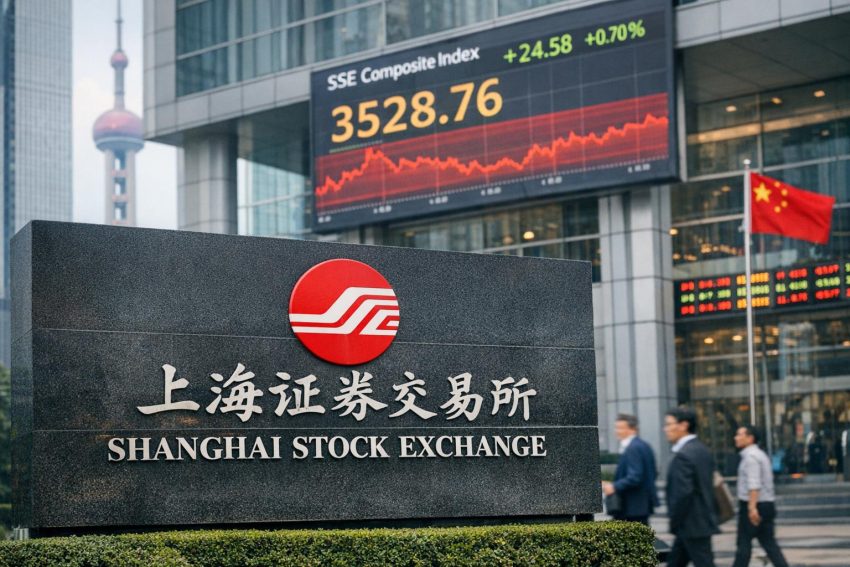
The Shanghai Stock Exchange (SSE) is one of mainland China’s two main stock exchanges and the largest mainland exchange by market capitalization. Based in Shanghai’s Pudong district, it provides organized markets for shares, bonds, exchange-traded funds, real estate investment trusts, asset-backed securities and other financial instruments.
The exchange plays a central role in corporate finance across China. Its listed issuers include state-owned groups, commercial banks, insurers, manufacturers, consumer businesses, pharmaceutical companies and technology firms. Some rank among the largest publicly traded companies in Asia. Others are smaller research-led businesses listed on the exchange’s Science and Technology Innovation Board.
The SSE operates within China’s regulated securities system. The China Securities Regulatory Commission (CSRC) acts as the national securities regulator, while the exchange administers listing standards, trading procedures, disclosure duties and market surveillance. Trading members, mainly licensed securities companies, connect investors to the exchange.
International access has expanded through Stock Connect and qualified-investor programs, but the SSE does not operate in the same manner as a fully open offshore market. Capital controls, foreign ownership rules, currency conversion requirements and domestic regulation continue to shape access. Investors therefore need to assess both company data and the institutional framework surrounding each trade.
History of the Shanghai Stock Exchange
Shanghai has a long association with securities trading. Markets for company shares and government debt appeared in the city during the late nineteenth century as Shanghai became a major commercial centre. The Shanghai Sharebrokers’ Association, founded in 1891, is often treated as an early predecessor of formal exchange trading in the city.
Securities activity changed after the establishment of the People’s Republic of China in 1949. Under the centrally planned economic model adopted in the following decades, public equity ownership and organized share trading largely disappeared. Companies relied on state allocation and bank funding rather than public securities markets.
Economic reforms introduced from the late 1970s gradually changed that model. State enterprises began experimenting with share issuance, while local governments tested new ways to raise capital. Informal and semi-organized trading venues appeared in Shanghai and other commercial centres during the 1980s.
The modern Shanghai Stock Exchange was formally established on November 26, 1990, and opened for trading on December 19, 1990. Only a small group of securities traded during its early period. Trading technology, disclosure standards and settlement procedures were also far less developed than those used by the exchange now.
The 1990s brought rapid expansion. More state-owned businesses issued shares, brokerage networks grew and individual participation increased. Regulators created separate share classes to control access and currency use. Renminbi-denominated A-shares initially served domestic investors, while foreign-currency B-shares were created mainly for overseas investors.
China later opened A-share access through institutional-investor programs and cross-border trading links. This reduced the former separation between domestic and overseas participants, although the two groups still face different account, custody and regulatory arrangements in some situations.
A major development came with the announcement of the Science and Technology Innovation Board in 2018. Usually called the STAR Market, the board began trading in July 2019. It introduced a registration-based initial public offering process, broader valuation approaches and wider daily price bands than those historically used on the SSE Main Board.
Registration-based listing was later expanded to the main boards of the Shanghai and Shenzhen exchanges in 2023. The reform placed greater weight on full disclosure, exchange review and legal accountability. Regulators retained oversight, so registration should not be mistaken for an automatic right to list.
Legal Status and Regulatory Structure
The Shanghai Stock Exchange is not a conventional shareholder-owned company. It operates as a not-for-profit legal entity under CSRC supervision and performs self-regulatory duties assigned under Chinese securities law.
Self-regulation allows the SSE to review listing applications, monitor trading, request explanations from issuers and impose disciplinary measures. It may issue warning letters, restrict trading accounts, refer suspected misconduct to regulators or begin delisting procedures. National law and CSRC policy remain above exchange rules.
Several institutions support the market’s operation. The China Securities Depository and Clearing Corporation, commonly known as ChinaClear, handles central securities registration, clearing and settlement. Licensed brokers accept customer orders and provide account services. Banks take part in fund transfers, custody and cross-border currency arrangements. Fund managers, insurers and pension institutions account for a growing share of institutional participation.
The regulatory structure also includes rules covering accounting, audits, corporate governance and public disclosure. The Ministry of Finance sets Chinese accounting standards, while audit firms review financial statements. Courts and administrative agencies deal with securities disputes, misrepresentation claims and enforcement matters.
This arrangement gives the state a large role in market development. Policy can affect listing activity, industry financing, trading rules and the timing of new products. That influence is not always negative; it has helped build market infrastructure quickly. Still, policy changes can alter valuations with little warning, so they belong in any serious risk assessment.
Main Board and STAR Market
The SSE is commonly discussed as two main equity segments: the Main Board and the STAR Market. Each serves a different issuer profile, though the distinction is not perfectly tidy.
SSE Main Board
The Main Board hosts many of China’s largest listed enterprises. Banks, energy producers, transport groups, industrial manufacturers, utilities and consumer companies feature heavily. State-controlled issuers have a strong presence, partly because Shanghai became the preferred listing venue for many large national enterprises.
Main Board issuers generally have established operating records and mature business structures. This does not make them low-risk. Large banks remain exposed to credit cycles, property conditions and interest-rate policy, while energy groups can be affected by commodity prices and government pricing rules.
The board also includes private-sector companies and medium-sized issuers. Investors should not assume that every Shanghai-listed Main Board share represents a state-owned blue chip. Ownership, voting control and government participation vary by company.
Science and Technology Innovation Board
The STAR Market focuses on research-led and technology-oriented issuers. Common areas include semiconductors, industrial software, biotechnology, medical equipment, advanced materials, clean energy and high-end manufacturing.
STAR applicants may use listing standards based on market value, revenue, research expenditure or expected commercial development. Some companies can list before reaching sustained profitability. That flexibility supports early-stage financing, but it also gives investors less historical earnings data on which to base a valuation.
The board permits weighted voting rights and certain red-chip structures where applicable rules are met. Such arrangements can allow founders to retain voting control despite holding a smaller economic interest. Shareholders should read the prospectus rather than rely on the board label alone.
STAR shares generally have wider daily price bands after their initial trading period. They may show sharper price movements than mature Main Board shares, particularly around clinical results, product approvals, semiconductor cycles or changes in industrial policy.
Companies Listed on the SSE
The exchange covers much of China’s corporate economy, but its sector mix differs from that of the Shenzhen Stock Exchange. Shanghai has historically carried greater weights in finance, energy, heavy industry, transport and state-controlled enterprises. Shenzhen has tended to contain more privately controlled manufacturers, technology businesses and smaller growth companies, though the distinction has narrowed.
Some Shanghai issuers maintain listings elsewhere. A company may have A-shares in Shanghai and H-shares in Hong Kong. It may also have depositary receipts or another overseas security. These instruments represent interests in the same corporate group but can trade at different prices.
Price gaps can persist because the investor bases, currencies, settlement systems and short-selling rules differ. Capital cannot always move freely enough to remove the gap through arbitrage. An A-share premium over the related H-share therefore does not automatically create an easy trade.
State ownership also requires closer examination. A company described as state-owned may be controlled by the central government, a provincial authority or a municipal body. Its commercial priorities may exist alongside employment, investment or policy duties. Minority investors need to consider how those duties could affect dividends, acquisitions and capital spending.
Private companies present another set of questions. Founder control, pledged shares, related-party dealings and rapid expansion can affect risk. The legal form of ownership matters less than the quality of governance and cash generation. A familiar brand is not a substitute for reading the accounts—a lesson markets repeat with impressive patience.
Securities Traded on the Shanghai Stock Exchange
Shares receive most media attention, but the SSE also runs large fixed-income and fund markets. Product rules differ, so an investor should confirm settlement, eligibility and price-band requirements before placing an order.
A-Shares
A-shares are ordinary shares quoted and traded in renminbi. They form the main domestic equity market and are held by individuals, mutual funds, insurers, pension funds, banks and approved overseas investors.
Foreign investors can access eligible A-shares through Stock Connect or approved institutional channels. Access does not place every investor under identical rules. Custody arrangements, beneficial ownership records, tax treatment and reporting duties can depend on the chosen route.
B-Shares
B-shares were created mainly for foreign participation. Shanghai B-shares trade in U.S. dollars, while Shenzhen B-shares trade in Hong Kong dollars. Domestic investors later received permission to participate under qualifying arrangements.
B-shares now occupy a relatively small part of the market. A-share access has become broader, and relatively few companies issue new B-shares. Liquidity can be thinner than in the related A-share, leading to wider bid-and-ask spreads and less efficient order execution.
Bonds and Convertible Securities
The SSE lists corporate bonds, government-related debt, policy-bank securities, exchangeable bonds and asset-backed securities. China also has a large interbank bond market, so exchange trading represents only one part of the country’s fixed-income activity.
Convertible bonds combine debt characteristics with the right to convert into company shares under stated conditions. Their prices can react to interest rates, issuer credit quality and the price of the underlying stock. Conversion terms, call provisions and redemption clauses can materially affect returns.
Convertible bonds are popular among some active traders because they may trade without the same next-day resale restriction applied to many A-shares. That does not make them simple instruments. A bond trading far above its conversion value can fall quickly if sentiment changes.
Exchange-Traded Funds
The SSE has a large market for exchange-traded funds (ETFs). Products track broad equity indexes, sectors, bonds, commodities and overseas markets. Some provide exposure to the SSE 50, CSI 300, STAR 50, government debt or gold.
ETFs can reduce single-company exposure, but they still carry market and tracking risk. A fund may trade above or below its net asset value during volatile periods. Overseas-asset ETFs can also show large premiums when cross-border investment quotas or creation activity restrict the supply of fund units.
Real Estate Investment Trusts
Public infrastructure real estate investment trusts, or REITs, trade on the SSE under China’s infrastructure REIT program. Their underlying assets may include toll roads, industrial parks, warehouses, energy facilities or rental housing projects.
These products differ from the commercial-property REIT model familiar in some other countries. Cash flow depends on the concession, lease or operating structure of the underlying infrastructure. Investors should assess debt, asset life, distribution policy and the rights retained by the original owner.
Trading Hours and Order Matching
SSE trading is electronic. Investors submit orders through licensed brokers, and the exchange matches eligible orders according to its rules. Direct retail membership is not the normal access model.
For ordinary share trading, the opening call auction generally runs from 9:15 a.m. to 9:25 a.m. Continuous trading takes place from 9:30 a.m. to 11:30 a.m. and from 1:00 p.m. to 2:57 p.m. A closing call auction normally operates from 2:57 p.m. to 3:00 p.m. Times use China Standard Time. Product schedules can differ, and the exchange closes on mainland public holidays.
During a call auction, the system groups orders and calculates a single execution price that matches the greatest tradable volume under the applicable method. Continuous trading matches orders as they arrive.
The order book generally uses price priority followed by time priority. A higher-priced buy order takes precedence over a lower-priced buy order. A lower-priced sell order takes precedence over a higher-priced sell order. If prices are equal, the earlier accepted order usually ranks first.
Market orders and limit orders may be available according to product and session rules. A marketable order seeks prompt execution but can receive a poor price if available liquidity is thin. A priced order controls the worst acceptable execution price but may remain unfilled.
Board Lots and Odd Lots
Buying A-shares commonly requires orders in round lots of 100 shares. Investors may generally sell a remaining odd lot in one order after corporate actions or partial executions leave a balance below 100 shares. Detailed rules can vary by security type.
Broker systems may reject orders that do not meet lot-size, tick-size or account-eligibility requirements. International investors should also account for foreign-exchange cut-off times and Hong Kong trading arrangements when using Stock Connect.
The T+1 Resale Restriction
Many mainland A-shares follow a T+1 resale convention. Shares purchased during one trading day generally cannot be sold until the next trading day. An investor can sell shares already held and buy more of the same company on that day, but newly purchased shares are not normally available for immediate resale.
This rule reduces ordinary same-day round trips in individual shares. It can also increase overnight exposure because a buyer cannot exit a new position before the session closes. Settlement rules for cash, bonds, ETFs and other instruments may follow different timetables.
Daily Price Bands and Trading Controls
The SSE uses daily price bands for many equities. Under the standard Main Board arrangement, an ordinary share can generally move by up to 10% above or below the prior closing reference price during a normal session. Risk-warning shares commonly have a narrower 5% band, subject to the applicable exchange rules.
STAR Market shares generally use a 20% daily band after the initial listing period. Under registration-based IPO rules, newly listed shares can trade without a standard daily band during their first five sessions, although temporary intraday suspension mechanisms may apply when prices move rapidly.
A price band does not guarantee liquidity. If a stock falls to the lower boundary and sell orders greatly exceed purchases, a shareholder may have no practical exit that day. The unfilled orders can return during the next session, allowing losses to accumulate across several days.
The exchange may request explanations for abnormal trading, suspend a security, monitor linked accounts or refer suspected manipulation and insider trading to the CSRC. It also monitors unusual order cancellations, concentrated account activity and trading around undisclosed corporate events.
Risk-Warning Designations
Companies facing financial, operational or governance problems can receive an ST designation, short for special treatment. The label warns that the issuer meets one or more risk criteria under exchange rules.
An ST marker is not a forecast that bankruptcy will occur, nor is it a promise that recovery will follow. It signals that investors should review the stated grounds, which can include weak financial results, audit concerns, operating problems or governance failures.
Delisting rules have become stricter over time. Financial tests, trading-price tests, disclosure violations and major legal breaches can lead to removal. Shell value once encouraged heavy speculation in distressed companies, but stronger delisting enforcement has made that approach harder to justify.
Major SSE and China Equity Indexes
Stock indexes provide reference points for performance measurement, fund management and derivatives. The terms Shanghai market and Shanghai Composite are often used as though they mean the same thing, but they do not.
| Index | Coverage | Common use |
|---|---|---|
| Shanghai Composite Index | Eligible A-shares and B-shares listed on the SSE | Broad measure of Shanghai-listed equities |
| SSE 50 Index | Large and liquid SSE-listed companies | Blue-chip performance and ETF tracking |
| SSE 180 Index | A broader group of leading Shanghai companies | Large-cap and sector representation |
| STAR 50 Index | Leading companies from the STAR Market | Technology and research-led equity exposure |
| CSI 300 Index | Large and liquid shares from Shanghai and Shenzhen | Broad mainland large-cap benchmark |
Shanghai Composite Index
The Shanghai Composite Index is the exchange’s most widely quoted indicator. It covers eligible stocks listed in Shanghai and uses market-capitalization weighting under its methodology. Large companies can therefore exert more influence than smaller issuers.
The index’s heavy exposure to banks, industrial groups and state-controlled businesses means it may not mirror the performance of consumer internet firms or smaller technology shares. A flat Composite Index can coexist with sharp gains or losses in other parts of the Chinese equity market.
SSE 50 and SSE 180
The SSE 50 Index represents a concentrated group of large, liquid companies. It is used by index funds, ETFs and equity derivatives. Concentration can make its performance sensitive to financial-sector and state-enterprise valuations.
The SSE 180 Index covers a broader selection of Shanghai companies. It aims to represent leading issuers across sectors while maintaining liquidity and investability criteria.
CSI 300 and STAR 50
The CSI 300 Index combines large and liquid A-shares from Shanghai and Shenzhen. It serves as a common benchmark for domestic funds, foreign institutions and index futures. Since it spans both exchanges, it often gives a broader picture of mainland large-cap equities than the Shanghai Composite alone.
The STAR 50 Index tracks major STAR Market companies. Semiconductor and industrial-technology shares often carry substantial weight, making the index sensitive to research spending, product cycles and technology policy.
Foreign Investment Access
Overseas participation in SSE-listed shares has grown, but access is channel-based. Investors generally use Stock Connect, a registered foreign institutional framework or funds that hold mainland securities.
Shanghai-Hong Kong Stock Connect
The Shanghai-Hong Kong Stock Connect began in November 2014. Its northbound channel allows eligible Hong Kong and overseas investors to trade approved Shanghai-listed shares through Hong Kong brokers. The southbound channel allows eligible mainland investors to buy approved Hong Kong-listed securities.
Northbound orders follow mainland trading hours, exchange rules and daily price bands. Stock Connect also applies a daily net-buy quota. The aggregate quota used during the program’s early years was removed, but daily controls remain subject to regulatory policy.
Not every Shanghai share qualifies. Eligibility may depend on index membership, market capitalization, share class and regulatory status. Securities can be added or removed after periodic reviews. A removed share may remain sellable for an existing holder even when new purchases are no longer accepted.
Trading calendars require care. Northbound trading generally needs both mainland and Hong Kong settlement arrangements to be open on the required days. A mainland session can therefore be unavailable through Stock Connect even though the SSE itself is trading.
Qualified Foreign Investor Framework
The Qualified Foreign Institutional Investor and Renminbi Qualified Foreign Institutional Investor programs were combined into a revised Qualified Foreign Investor framework. Registered institutions can invest in approved domestic securities through local custodians and brokers.
This route can offer broader product access than Stock Connect, but it brings registration, custody, reporting and compliance duties. It is used mainly by professional asset managers, sovereign institutions, banks, insurers and other qualifying organizations.
Foreign Ownership Restrictions
Foreign holdings are subject to ownership thresholds under Chinese rules. General thresholds have historically applied both to a single foreign investor and to aggregate foreign ownership of one listed company. Separate sector laws can impose tighter requirements.
Exchange systems monitor foreign ownership levels and may restrict additional purchases as a threshold approaches. Investors should verify the current percentage before trading a company with high overseas participation. Rules and calculation methods can be amended, so old broker guides are not always reliable.
Currency, Custody and Tax
A-shares trade in renminbi. An overseas investor may fund the trade in Hong Kong dollars or another currency, with conversion handled through the broker and clearing structure. Exchange-rate changes can raise or reduce the return measured in the investor’s home currency.
Stock Connect holdings are generally recorded through a nominee structure involving Hong Kong Securities Clearing Company and mainland registration arrangements. Beneficial ownership has regulatory recognition, but voting, corporate actions and legal claims may follow procedures different from direct domestic holdings.
Tax treatment can cover dividends, capital gains, stamp duty and local withholding. Temporary exemptions and policy notices have changed at various points. Investors should use current tax guidance rather than assume that treatment from an earlier year still applies.
Listing, IPO and Disclosure Rules
An issuer applying to the SSE must submit a prospectus, audited accounts, legal opinions and corporate-governance records. The exchange reviews whether the filing meets the relevant board’s conditions and whether disclosure gives investors a fair basis for assessment.
Under the registration-based IPO model, the exchange conducts the review and submits an approved application for CSRC registration. Registration does not amount to a government guarantee of business quality, profitability or future share performance.
Applicants may receive several rounds of written questions concerning revenue recognition, customers, suppliers, ownership, intellectual property, related-party transactions and risk statements. Responses become part of the public filing record. False disclosure can lead to administrative penalties, civil claims and criminal referral.
Continuing Disclosure
After listing, companies publish annual reports, half-year reports and quarterly financial data under the applicable rules. They must also announce material events promptly.
Reportable events can include mergers, major contracts, asset sales, guarantees, litigation, regulatory investigations, changes in control and large investment losses. Share pledges by controlling owners can also merit close attention because forced sales may affect both control and market price.
Trading can be suspended while a company prepares an announcement, though regulators have reduced the use of long suspensions. Long halts prevent shareholders from selling and can hide accumulated price pressure rather than remove it.
Audits and Accounting
Mainland issuers generally report under Chinese Accounting Standards for Business Enterprises. These standards share many principles with International Financial Reporting Standards, but differences can arise in interpretation, presentation and application.
Investors should compare net profit with operating cash flow, review receivables and examine changes in auditor opinion. Related-party balances, government grants and fair-value gains can have a large effect on reported earnings. A healthy income statement paired with persistent negative operating cash flow deserves more than a quick shrug.
Market Data and Company Analysis
SSE market analysis should combine valuation, earnings quality, ownership and policy exposure. Relying on the Shanghai Composite alone provides little information about an individual company.
Valuation ratios such as price-to-earnings, price-to-book and dividend yield are widely used. Their relevance varies by sector. Price-to-book may help when assessing banks, while revenue growth and research expenditure may carry more weight for an early-stage technology company.
Free-float market capitalization also matters. Some state-controlled companies have a large total share count but a smaller freely traded portion. Low free float can amplify price movement and make quoted market value less representative of the capital available for trading.
Ownership records can show whether the controlling shareholder is a central state group, local authority, founder or investment company. Investors should examine pledged holdings, recent placements, lock-up expirations and planned reductions by major shareholders.
Policy exposure belongs in sector analysis. Property developers can react to mortgage and financing rules. Pharmaceutical companies may be affected by centralized procurement. Semiconductor issuers can respond to subsidies, export controls and equipment access. Banks are influenced by lending policy, deposit pricing and asset-quality trends.
Role of Brokers in SSE Trading
Investors trade SSE securities through brokers rather than sending orders straight to the exchange. Domestic customers normally open an account with a licensed Chinese securities company. Overseas customers commonly use a Hong Kong broker offering Stock Connect or an international broker connected to a qualifying local participant.
Broker services can differ in market coverage, currency conversion, research, order types and corporate-action handling. A low headline commission may sit beside custody fees, platform charges or an unfavourable foreign-exchange spread.
Execution quality deserves attention, especially in thinner B-shares, small companies and ETFs trading away from net asset value. Large marketable orders can move through several price levels. A priced order may offer better control, though there is no promise of execution.
Investors should also confirm whether their broker supports voting, rights issues, tender offers and tax documentation. Corporate actions can have short response windows, and an overseas intermediary may set an earlier cut-off than the issuer.
Economic Role of the SSE
The SSE gives companies an alternative to bank loans and state funding. Equity issuance can finance factories, research, acquisitions and balance-sheet repair. Bond issuance can provide longer-term funding or replace existing debt.
This function matters in China because bank lending has traditionally dominated corporate finance. A larger securities market can distribute funding across households, mutual funds, insurers and pension institutions rather than concentrating credit exposure in banks.
The exchange also supports state-enterprise reform. Listing can introduce audited reporting, outside shareholders and public valuation. Yet listing does not remove state control or policy duties. Some companies remain majority-owned by government bodies after only a minority stake is sold to the public.
The STAR Market directs private capital toward research-heavy industries such as semiconductors, biotechnology and advanced manufacturing. Public financing can help firms that lack hard assets for conventional bank collateral. Investors accept higher business risk in return for possible growth, though not every laboratory turns into a profitable company.
For households, exchange-listed shares and funds offer another savings channel beside deposits and property. Retail trading remains influential, which can contribute to high turnover and rapid changes in sentiment. Institutional ownership has grown through mutual funds, insurance portfolios, pension programs and foreign investment.
Main Risks for Investors
SSE securities carry ordinary equity risk along with risks linked to China’s legal, policy and trading framework. None should be assessed in isolation.
Policy and Regulatory Risk
Government policy can change business economics quickly. Rules affecting property finance, online platforms, education, healthcare pricing or industrial capacity may alter revenue and valuation assumptions. A company can remain operational while its expected profit model changes sharply.
Liquidity and Price-Band Risk
Large companies and index ETFs often trade actively, but smaller shares can have thin order books. Daily price bands can prevent immediate execution during a sell-off. A displayed price at the lower boundary has little practical value if no buyers are present.
Corporate Governance Risk
Controlling shareholders may influence board appointments, asset transactions and financing decisions. Related-party sales or purchases can transfer value between a listed issuer and its parent group. Investors need to examine both transaction terms and the independence of approval procedures.
Accounting and Disclosure Risk
Late announcements, aggressive revenue recognition and weak internal controls can distort valuation. Regulatory standards have strengthened, but rules cannot remove every reporting failure. Auditor changes, qualified opinions and repeated corrections are warning signs.
Currency and Cross-Border Risk
An A-share gain measured in renminbi can become a smaller gain, or a loss, after conversion into another currency. Cross-border trading can also be affected by holidays, ownership thresholds, custody procedures and changes in diplomatic relations.
Macroeconomic Risk
Economic growth, consumer spending, property activity, exports, interest rates and local-government debt all affect Shanghai-listed companies. Sector exposure is uneven. Banks react to credit quality, industrial groups to investment demand and consumer businesses to household income.
SSE Compared With Other Exchanges
The Shanghai Stock Exchange ranks among the largest equity exchanges globally by market value. Its structure, however, differs from that of the New York Stock Exchange, Nasdaq, Hong Kong Exchanges and Clearing, and the Shenzhen Stock Exchange.
State-controlled enterprises carry more weight in Shanghai than on most large Western exchanges. Retail investors also account for a notable share of turnover. Short selling, securities lending and derivatives exist, but access and usage rules are more restrictive than in several mature markets.
Compared with Shenzhen, Shanghai has greater exposure to banks, energy, transport and large industrial groups. Shenzhen tends to carry more private-sector manufacturing and growth shares. The STAR Market has narrowed the technology gap by bringing more semiconductor, biotechnology and advanced-equipment companies to Shanghai.
Hong Kong operates under a separate legal, currency and trading system. It offers broader foreign access and no mainland-style daily price bands for ordinary shares. Companies listed in both Shanghai and Hong Kong may therefore show different liquidity, valuation and investor behaviour.
Shanghai should also not be treated as a complete proxy for China’s economy. Many major private companies list in Hong Kong or overseas, while unlisted state groups and small businesses account for large amounts of employment and output. SSE indexes measure listed securities, not national production.
How to Assess an SSE Investment
A practical review starts with the exact security and access route. Investors should identify whether the instrument is an A-share, B-share, ETF, bond or REIT, then confirm trading currency, settlement, lot size and resale rules.
The next step is to examine the issuer’s ownership and board segment. A Main Board bank requires a different valuation approach from a pre-profit STAR biotechnology company. Comparing both on the same earnings multiple would produce little useful insight.
Financial review should cover revenue quality, operating cash flow, debt, receivables, margins and capital spending. Ownership analysis should include controlling shareholders, pledged stock and related-party transactions. Policy analysis should focus on the company’s revenue sources rather than broad statements about China.
Trading conditions also matter. Investors should check average turnover, bid-and-ask spreads, Stock Connect eligibility and foreign ownership headroom. A well-researched investment can still produce poor execution if the order is too large for the available liquidity.
The Shanghai Stock Exchange combines a large domestic capital market with strong regulatory direction, growing institutional participation and controlled foreign access. Its Main Board provides exposure to established financial and industrial groups, while the STAR Market offers access to research-led companies with higher operating and valuation risk.
Careful analysis requires more than tracking the Shanghai Composite. Investors need to read company filings, confirm current exchange rules and account for policy, currency, liquidity and governance. The SSE offers broad exposure to Chinese corporate activity, but its rules and ownership structures deserve the same attention as earnings and share price.