
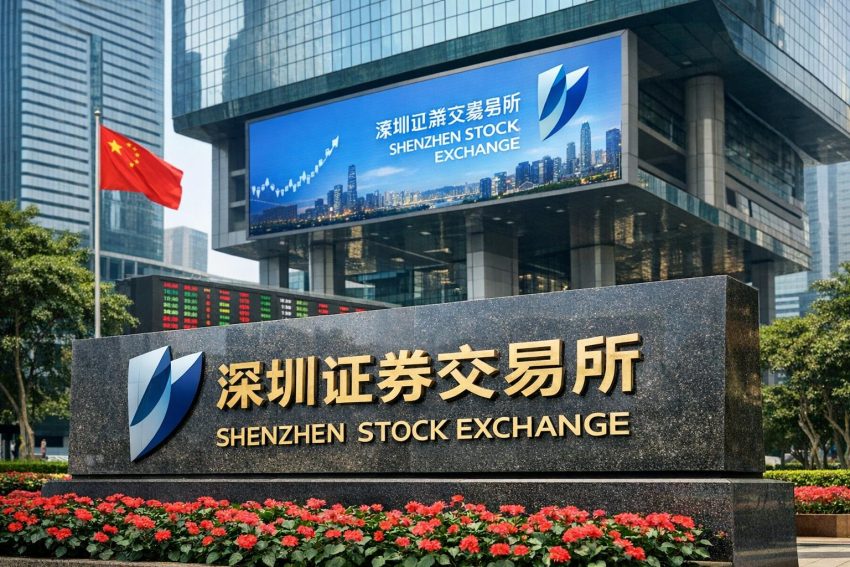
The Shenzhen Stock Exchange, commonly known as the SZSE, is one of mainland China’s three securities exchanges and one of its two long-established equity markets. It provides a regulated venue where companies can issue shares, investors can trade securities, and market prices can form through electronic order matching. The exchange lists many businesses connected with technology, manufacturing, consumer goods, healthcare, renewable energy, transportation and industrial services.
The SZSE is based in Shenzhen, Guangdong province, near Hong Kong. Shenzhen grew from a small border city into a major centre for electronics, telecommunications, finance and manufacturing after becoming one of China’s first special economic zones in 1980. That commercial history influenced the exchange. Compared with the Shanghai Stock Exchange, which has traditionally listed more large state-owned banks, energy groups and heavy industrial companies, Shenzhen has a stronger association with private businesses, mid-sized manufacturers and growth-oriented companies.
This distinction should not be treated as an absolute rule. The SZSE Main Board includes mature state-owned and privately controlled companies, while Shanghai also lists privately owned technology businesses. Even so, differences in sector weighting and company size can cause the two exchanges and their benchmark indexes to perform quite differently during the same period.
History of the Shenzhen Stock Exchange
The Shenzhen Stock Exchange was founded in December 1990 during the early development of China’s modern securities market. It received formal recognition from the national authorities in 1991. Its creation formed part of China’s gradual introduction of share ownership, public capital raising and market-based pricing under close government supervision.
China had issued shares before the SZSE opened, but trading was fragmented and local. The establishment of formal exchanges in Shenzhen and Shanghai created organised markets with standard trading procedures, listing rules and centralised settlement. Early systems were modest by later standards. Regulation, accounting practices and investor protections were still being developed, and retail trading accounted for much of the activity.
Shenzhen’s status as a testing ground for economic reform gave the exchange a natural supply of potential issuers. Local and regional companies needed capital for factories, machinery, research, distribution and expansion. Public share offerings gave some of them an alternative to relying entirely on bank loans or government funding.
After rapid growth during the 1990s, new listings in Shenzhen were paused for several years as policymakers considered the division of functions between the mainland exchanges. New issuance resumed with the creation of the Small and Medium Enterprise Board in 2004. Usually called the SME Board, it served established companies whose scale was below that of many traditional Main Board issuers.
The exchange opened ChiNext in October 2009. This board was designed for innovative and growth-oriented businesses, including companies that might have shorter operating histories or more variable earnings than mature Main Board issuers. ChiNext gave founders and venture-capital investors a domestic route to public ownership while providing investors with access to younger companies.
In August 2020, ChiNext began operating under a registration-based initial public offering system. The reform revised issuance review, trading limits and investor eligibility arrangements. It also allowed listing standards to consider measures other than a long record of positive net profit, subject to the applicable rules.
The SME Board merged with the Main Board in April 2021. Existing SME Board companies continued trading, but the separate classification was removed. The change left the exchange with two primary share markets: the Main Board and ChiNext.
China expanded registration-based share issuance across its domestic stock markets in 2023. Shenzhen Main Board IPOs then moved from the former approval model to the registration framework. The reform changed the division of work between the exchange and the China Securities Regulatory Commission, or CSRC, without removing regulatory examination.
Ownership, supervision and market administration
The SZSE is not a broker and does not buy shares on behalf of retail investors. It organises trading, maintains the electronic order book, reviews listing applications, monitors disclosure and administers its market rules. It also conducts trading surveillance and may ask listed companies to explain unusual price movements, media reports or apparent disclosure problems.
The exchange operates under the supervision of the CSRC, China’s national securities regulator. The CSRC writes and administers securities regulations, registers eligible public offerings, investigates suspected misconduct and may impose administrative penalties. Courts, public security agencies and other government bodies may become involved where conduct raises civil or criminal issues.
China Securities Depository and Clearing Corporation Limited, better known as ChinaClear, handles central securities registration, clearing and settlement for the mainland exchanges. Brokerage firms connect customers to the market, conduct identity checks, receive orders and maintain trading accounts. Investment banks, accounting firms and law firms also take part in share offerings and continuing compliance work.
This division of responsibilities matters. An exchange listing does not represent a guarantee from the SZSE, the CSRC or an issuer’s advisers. Review focuses on compliance and disclosure. Investors still bear the commercial risk of buying the shares.
SZSE Main Board and ChiNext
Main Board
The SZSE Main Board serves companies with established operations and mature business models. Its issuers include manufacturers, property-related businesses, retailers, food and beverage producers, transport companies, utilities, pharmaceutical groups, software developers and financial-service providers.
Main Board companies vary widely in size. Some rank among China’s largest publicly traded businesses, while others came from the former SME Board and retain a mid-cap profile. Ownership structures also vary. A company may be controlled by private founders, a local government, a central state-owned group or a mix of institutional and public shareholders.
The registration-based Main Board framework places considerable weight on clear business operations, standard corporate governance and complete disclosure. Financial eligibility standards can include measures relating to profit, revenue, operating cash flow and market value. The precise route depends on current regulations and the issuer’s circumstances.
ChiNext
ChiNext is associated with innovative companies and businesses in growth industries. Common fields include medical devices, industrial automation, software, electronics, batteries, environmental equipment, biotechnology and advanced materials. The board is sometimes compared with growth markets such as Nasdaq, although its legal structure, listing standards and trading rules remain Chinese.
A ChiNext company may reinvest heavily in research, equipment, sales networks or production capacity. That spending can support expansion, but it may also reduce near-term profit and increase funding needs. Investors therefore tend to pay close attention to revenue quality, research expenditure, gross margins, customer concentration and the path to positive cash flow.
ChiNext accepts more than one financial listing route. Certain applicants may qualify through combinations of expected market value, revenue, profit or research characteristics rather than through one uniform earnings test. This approach gives innovative issuers more ways to reach the public market, though it can also place greater responsibility on investors to assess uncertain future earnings.
The board uses investor-appropriateness rules. A retail customer who applies for ChiNext trading permission generally has to meet minimum account-history and asset conditions, acknowledge the risks and complete the broker’s assessment process. Requirements may change, and brokers may apply compliance checks beyond the basic exchange rules.
| Feature | SZSE Main Board | ChiNext |
|---|---|---|
| Typical issuer profile | Established companies across many industries | Innovative or growth-oriented companies |
| IPO system | Registration-based | Registration-based |
| Standard daily price limit | Usually 10% | Usually 20% |
| Retail access | Standard A-share account access | Extra suitability conditions generally apply |
| Common investor focus | Earnings, dividends, assets and market position | Growth, research, scalability and valuation |
The table describes general arrangements rather than every exception. Risk-warning shares, newly listed companies and certain corporate actions can lead to other trading conditions.
Types of securities traded on the SZSE
A-shares
A-shares are the main equity securities listed in Shenzhen. They are quoted and traded in renminbi and represent ownership in mainland-incorporated companies. Domestic individuals and institutions account for much of the trading, though overseas investors can gain access through approved programmes.
Shareholders may receive dividends, vote at shareholder meetings and take part in rights offerings, subject to company law, the articles of association and account arrangements. Voting power normally reflects the number of shares held, though control structures and state ownership can affect the practical influence of public shareholders.
B-shares
The SZSE also operates a B-share market. Shenzhen B-shares are issued by mainland companies but quoted and traded in Hong Kong dollars. They were introduced during an earlier stage of market opening, when direct foreign participation in A-shares was heavily restricted.
B-shares now occupy a smaller place in China’s equity market. Stock Connect and institutional access programmes have given foreign investors broader routes into renminbi securities. Many B-share counters have lower turnover than actively traded A-shares, which can lead to wider bid-ask spreads.
Funds and exchange-traded funds
The exchange lists exchange-traded funds, or ETFs, covering broad indexes, industry groups, bonds, commodities and investment strategies. ETFs trade through brokerage accounts in much the same manner as shares, but each fund holds a portfolio or uses another approved method to track its stated benchmark.
An ETF can reduce dependence on the fortunes of one company. It does not remove market risk, tracking error, management fees or liquidity concerns. Investors should also check whether a fund invests directly in its target assets, uses derivatives or tracks an overseas benchmark during hours when the foreign market is closed.
Bonds and convertible bonds
Government-related bonds, corporate bonds, asset-backed securities and other debt instruments may trade through the SZSE. The exchange also has an active market for convertible bonds. A convertible usually pays interest and gives its holder the right to convert the bond into shares according to stated terms.
Convertible prices respond to both credit conditions and the price of the related stock. Redemption clauses, conversion-price adjustments and trading rules can cause sharp moves. The product may look like a plain bond at first sight, but its equity option can change its behaviour rather quickly.
Other products
The exchange may support real estate investment trusts, listed open-ended funds, options and other products approved under Chinese regulations. Trading units, settlement arrangements and eligibility rules differ by product. A brokerage platform may display them in one account, but that does not mean they operate in the same manner.
How companies list on the SZSE
A company planning an IPO usually appoints a sponsoring securities firm, accountants and legal advisers. The company then prepares application documents that describe its operations, finances, ownership, management, business risks and proposed use of the offering proceeds.
The prospectus normally covers the issuer’s products and services, revenue model, major customers, major suppliers, competition, intellectual property, employees, legal proceedings and related-party dealings. It also identifies controlling shareholders, directors, senior managers and parties whose interests may affect corporate decisions.
Audited financial statements allow reviewers and investors to examine revenue, expenses, assets, liabilities and cash flows. The numbers alone rarely tell the whole story. An issuer may report rising profit while receivables grow faster than sales, or it may produce accounting earnings without generating much operating cash. Review questions often focus on such mismatches.
Under the registration system, the exchange examines whether the applicant meets issuance and listing rules and whether its disclosures are complete and consistent. The SZSE can issue several rounds of written questions. The issuer and its advisers publish responses, revise documents and provide supporting evidence where requested.
After the exchange completes its review, the application proceeds to the CSRC for registration under the governing process. Registration is not an investment endorsement. It indicates that the offering has passed the prescribed regulatory procedure.
IPO pricing may involve inquiries from eligible institutional investors, with the final offer terms set under applicable issuance rules. Once the shares begin trading, market supply and demand determine the price. A popular IPO can trade far above its issue price, while another can decline. The offer price itself provides no floor.
Continuing disclosure and corporate governance
Listing obligations continue after the IPO. SZSE companies publish annual reports and interim reports, along with other financial updates required by current rules. Annual financial statements generally require an external audit. Companies must also report material corporate developments without waiting for the next scheduled report.
Reportable matters can include mergers, asset purchases, disposals, major contracts, lawsuits, guarantees, changes in control, large losses, debt problems and changes involving directors or senior executives. Transactions with controlling shareholders and related parties receive close attention because they can transfer value away from public shareholders.
China’s disclosure system relies on designated filing channels and standard document formats. Investors should read the formal announcement rather than depend only on social media, message boards or a short news summary. A company announcement may contain qualifications that disappear when the story is reduced to a headline.
Listed issuers must maintain governance arrangements covering shareholder meetings, boards of directors, audit oversight and internal controls. Independent directors are expected to review matters where controllers or managers may have conflicts. Shareholders can vote on board appointments, major transactions and other proposals reserved for shareholder approval.
Controlling shareholders, directors and early investors may face lock-up periods or sale restrictions. Rules also govern share reductions, insider trading and short-swing transactions. The exchange can send inquiry letters, issue supervisory measures or impose disciplinary sanctions where a company or responsible person breaches its obligations.
Trading hours and order matching
SZSE securities trade through an electronic central order book. Investors submit orders to a licensed broker, and the broker sends accepted instructions to the exchange. Matching generally follows price priority and then time priority. A higher-priced buy order takes precedence over a lower-priced buy order, while a lower-priced sell order takes precedence over a higher-priced sell order.
The normal A-share schedule uses morning and afternoon sessions:
-
9:15 to 9:25: opening call auction, with restrictions on order cancellation during part of the period.
-
9:30 to 11:30: morning continuous trading.
-
13:00 to 14:57: afternoon continuous trading.
-
14:57 to 15:00: closing call auction.
Some products and block-trading arrangements use other windows. Mainland markets also close on public holidays that may not match holidays in Hong Kong, Europe or North America. That mismatch matters for Stock Connect users because both markets and their clearing systems may need to be open for a trade to proceed.
Investors can usually enter limit orders, stating the highest purchase price or lowest sale price they will accept. Market-style instructions may also be available under exchange and broker rules, but they do not guarantee a favourable execution price. In a fast-moving stock, the best available quote can change before an order reaches the book.
Trading lots
A-share purchase orders are generally entered in board lots of 100 shares or whole multiples of 100. An investor may sell an odd-lot balance in one order if a corporate action or prior transaction leaves a holding that is not a full board lot. Product rules can differ for ETFs, bonds and other securities.
T+1 share trading
Mainland A-shares follow a trading restriction commonly described as T+1. Shares bought on one trading day generally cannot be sold until the next trading day. An investor can sell shares already held and can use cash according to the broker’s account and settlement arrangements, but a newly purchased stock position is not available for same-day resale.
This rule reduces conventional day trading in the same shares, though it does not prevent rapid speculation across different securities. It can also increase overnight exposure. News released after the close may affect the price before a buyer has the right to exit the new position.
Daily price limits and trading controls
Most SZSE shares are subject to daily price limits calculated from the previous closing price or another exchange reference price. A standard Main Board share usually has a 10% upward and downward limit. ChiNext shares usually use 20% limits.
Companies carrying a risk-warning designation may be subject to altered limits. Newly listed shares can also trade without the standard limit during an initial period under the registration-based rules. Intraday controls may apply where an unrestricted stock rises or falls rapidly.
A daily limit does not guarantee liquidity. If a stock reaches its lower limit and sell orders greatly exceed buy orders, an investor may not be able to sell. The order can remain in the queue without execution. Repeated limit-down sessions are possible when adverse news changes the market’s estimate of a company’s value.
The SZSE monitors abnormal trading patterns, including rapid order submission and cancellation, coordinated account activity, suspected manipulation and trading connected with inside information. It may request account data from brokers, restrict trading in serious cases or refer suspected violations to the CSRC.
Risk warnings, suspension and delisting
China’s exchanges use risk-warning labels for companies facing financial, operational or compliance concerns. The abbreviation ST commonly appears in the short name of a company placed under special treatment. A more severe designation may apply where the company faces a delisting risk.
Reasons can include weak audited financial results, qualified audit opinions, failures in disclosure, problems with internal controls or uncertainty about continued operations. Investors should read the announcement that explains the designation; the label alone does not describe every issue.
Trading may be suspended during major corporate events, although regulatory policy has placed greater emphasis on avoiding unnecessarily long suspensions. A halt stops trading but does not remove economic risk. When trading resumes, accumulated buy or sell interest may cause a sharp price adjustment.
Delisting rules cover several categories. A company may leave the exchange because its trading price or market indicators remain below required levels, because its financial condition meets a delisting test, because it commits a serious legal violation, or because it repeatedly fails to meet disclosure and governance duties.
Some delisted shares may move to another quotation arrangement, but investors should not assume there will be an active market. Delisting can reduce liquidity, access to corporate data and the practical value of minority holdings.
Major SZSE indexes
Shenzhen Component Index
The Shenzhen Component Index, often identified by the code 399001, is the exchange’s best-known benchmark. It tracks a selected group of SZSE-listed A-shares using published eligibility, weighting and review methods. It is broader than a single-sector index but does not represent every Shenzhen-listed company in equal measure.
Sector composition affects its behaviour. A benchmark with substantial exposure to electronics, consumer companies and industrial manufacturers may respond differently from an index dominated by banks, oil producers or utilities.
ChiNext Index
The ChiNext Index, commonly associated with code 399006, tracks leading shares from the ChiNext board. It often carries greater exposure to medical technology, electrical equipment, software, industrial automation and other growth industries.
Valuation changes can have a large effect on growth indexes. When investors are willing to pay higher multiples for expected future earnings, ChiNext shares may rise faster than mature value stocks. When earnings forecasts fall or discount rates rise, the same valuation structure can work in reverse.
Other Shenzhen indexes
The SZSE and affiliated index providers publish benchmarks covering large companies, smaller companies, dividends, industries and investment styles. The SZSE 100 is one widely followed large-company measure. There are also indexes designed for fund tracking and cross-market analysis.
Index membership changes during periodic reviews. Selection can depend on free-float market value, turnover, trading history and other stated criteria. Being added to a benchmark can create demand from index funds, but inclusion says little about whether a share is attractively priced.
International investor access
Shenzhen-Hong Kong Stock Connect
Shenzhen-Hong Kong Stock Connect began operating in December 2016. Its northbound channel allows eligible Hong Kong and overseas investors to buy approved Shenzhen shares through Hong Kong brokers. Its southbound channel allows qualified mainland investors to buy approved Hong Kong securities.
Northbound trading uses the rules and currency arrangements set for the programme. Orders are routed through the exchange link, while renminbi conversion and clearing occur through participating institutions. A daily quota controls the aggregate value of net purchases, although the eligible-share list and quota rules may be revised over time.
Not every SZSE share is available through Stock Connect. Eligibility depends on criteria such as index membership, market value, share classification and regulatory status. A security can be removed from the buy list while existing foreign holders remain permitted to sell it.
Stock Connect investors need to account for holiday calendars, pre-trade checking, settlement procedures and foreign ownership limits. Corporate voting and entitlement processing may also work through nominee arrangements rather than through direct registration in the end investor’s name.
Qualified foreign investor programmes
Approved foreign institutions can invest through China’s qualified foreign investor framework. Earlier programmes known as QFII and RQFII were consolidated under revised rules that broadened eligible investments and simplified parts of the access process.
This route is commonly used by asset managers, banks, insurers, pension investors and other institutions. It allows direct participation under Chinese account, custody, reporting and compliance requirements. The structure can be more operationally demanding than buying a fund outside mainland China.
Funds and indirect exposure
Investors may also gain Shenzhen exposure through ETFs, mutual funds or depositary products available in their home markets. Indirect access can simplify custody and currency handling, but fund fees, tracking differences and portfolio construction can cause returns to depart from an SZSE benchmark.
The SZSE’s role in corporate finance
An SZSE listing allows a company to raise equity through an IPO and, after listing, through rights issues, private placements or other authorised transactions. Equity does not require scheduled repayment in the same form as a bank loan or bond, although issuing new shares dilutes existing ownership.
Companies may use proceeds to expand production, buy equipment, fund research, build sales networks, repay debt or purchase other businesses. Investors should compare actual spending with the use described in the offering documents. Delays, revised projects and idle cash can weaken the expected benefit of an issue.
A public share price also gives companies a reference valuation for mergers, employee share plans and financing negotiations. Founders and early investors gain a possible route to sell holdings after lock-ups expire. These sales can increase the public float, but large disposals may place pressure on the market price.
Listing can improve access to lenders, suppliers and skilled staff because it requires regular reporting and provides a visible valuation. It can also increase compliance costs and public scrutiny. Management teams must spend time on disclosure, investor communication, audits and board procedures rather than concentrating only on operations.
Economic sectors represented in Shenzhen
The exchange has close links with southern China’s manufacturing base. Listed companies produce electronics, appliances, vehicle parts, industrial machinery, chemicals, medical equipment and construction materials. Many operate national or international supply chains rather than serving only Guangdong.
Technology-related issuers form another prominent group. They include software developers, telecommunications suppliers, semiconductor businesses and automation companies. The commercial results of such firms depend on research productivity, customer adoption, pricing power and access to skilled employees.
Consumer companies listed in Shenzhen sell food, beverages, household products, clothing, media services and retail goods. Their results can provide evidence about household demand, pricing and changes in consumer preferences. Some well-known Chinese consumer brands have built large domestic shareholder bases through SZSE listings.
Renewable energy and electric-vehicle supply chains are also well represented. Battery makers, electrical-equipment manufacturers, solar businesses and materials suppliers have raised capital through Shenzhen. High sector growth can attract new competitors and large investment programmes, so rising industry output does not always produce rising profit margins.
Comparison with Shanghai, Beijing and Hong Kong
The Shanghai Stock Exchange is Shenzhen’s principal mainland counterpart. Its Main Board has a heavier weighting in large banks, insurers, energy groups and state-controlled industrial companies. Shanghai also operates the STAR Market, launched in 2019 for science and technology issuers.
ChiNext and STAR both serve innovative companies, but they differ in issuer mix, listing positioning and investor rules. A technology company’s choice between them can depend on its industry, financing plan, adviser recommendations and ability to meet the relevant standards.
The Beijing Stock Exchange, opened in 2021, focuses on innovative small and medium-sized enterprises. It has close links with the National Equities Exchange and Quotations system. Its companies are generally smaller than the large issuers found on the Shenzhen and Shanghai Main Boards.
The Hong Kong Stock Exchange operates under Hong Kong law, uses the Hong Kong dollar and has a different investor base. Some Chinese companies maintain both mainland A-shares and Hong Kong H-shares. Prices may diverge because the two share classes face different demand, currency, settlement and access conditions.
| Exchange or board | General market association | Trading currency |
|---|---|---|
| SZSE Main Board | Established private, local state-owned and industrial companies | Renminbi for A-shares |
| ChiNext | Growth and innovative companies | Renminbi |
| Shanghai Main Board | Large financial, energy and industrial groups | Renminbi for A-shares |
| STAR Market | Science and technology companies | Renminbi |
| Beijing Stock Exchange | Innovative smaller enterprises | Renminbi |
| Hong Kong Stock Exchange | Hong Kong, mainland and international issuers | Hong Kong dollars |
Risks for investors
Company and accounting risk
A listed company can lose customers, misjudge demand, accumulate debt or spend poorly. Investors should review operating cash flow, receivables, inventory, borrowing costs and capital expenditure rather than relying on revenue growth alone. Repeated reliance on asset sales, subsidies or non-recurring gains can make reported profit look stronger than the underlying business.
Ownership also deserves attention. A controlling shareholder may influence board appointments, financing and related-party transactions. Pledged founder shares can create pressure if the share price falls and lenders demand more collateral.
Valuation and sector risk
Growth shares often trade on forecasts several years ahead. Small changes in expected margins or sales can produce large changes in estimated value. A good company can still be a poor investment if the purchase price assumes near-perfect execution.
Sector concentration raises another concern. An investor who owns several battery, semiconductor or medical-device shares may appear diversified by company count while remaining exposed to the same policy, pricing and demand cycles.
Regulatory and policy risk
Chinese industries operate within policy frameworks that can change. Rules concerning data, finance, property, healthcare, education, emissions and overseas business may affect revenue models or compliance costs. Policy support for an industry does not guarantee that every company in it will prosper.
Liquidity and price-limit risk
Trading volume varies widely. Large index constituents may trade actively, while smaller shares can have thin order books. Daily price limits can postpone price adjustment rather than prevent it. A holder may see a stock at its lower limit for several sessions without finding a buyer.
Currency and access risk
A foreign investor measures returns in a home currency as well as renminbi. A share-price gain can be reduced by adverse exchange-rate movement. Access programmes may also change eligible lists, ownership caps, settlement procedures or tax treatment.
How to assess an SZSE-listed company
Analysis normally starts with the company’s formal filings. The annual report should be compared with earlier periods to identify changes in sales, margins, cash flow, debt and share count. Notes to the financial statements often reveal more than the headline figures, particularly on receivables, guarantees, subsidiaries and related parties.
Investors can then review the business model. Useful questions include whether customers make repeat purchases, whether the company has pricing power, how much it spends to win sales and whether production capacity is being used efficiently. A manufacturer building new plants faster than demand grows may face falling utilisation and weaker returns.
Management incentives matter as well. Share ownership can align founders with outside investors, but concentrated control can also weaken minority influence. Pay plans, share pledges, insider sales and related-party dealings provide context for management decisions.
Announcements deserve regular monitoring after purchase. Profit warnings, auditor changes, regulatory inquiries and revised forecasts can alter the investment case. Waiting for the next annual report may be rather late if the company has already disclosed a material problem.
Ongoing market reform
The SZSE continues to change as China develops registration-based issuance, delisting rules, investor access and enforcement. Authorities have placed greater emphasis on issuer responsibility, intermediary accountability and the quality of public filings. They have also promoted institutional investment and longer holding periods.
Technology plays a large part in exchange operations. Electronic surveillance systems analyse orders, account relationships and trading patterns. Online filing systems allow public access to prospectuses, review questions and company announcements. Faster publication helps the market process news, though speed cannot correct inaccurate or incomplete reporting on its own.
Future reforms may address settlement, derivatives, cross-border investment, shareholder returns and the treatment of troubled companies. The direction of policy often reflects two competing aims: helping businesses raise capital and controlling conduct that could weaken market confidence.
The Shenzhen Stock Exchange remains closely associated with China’s private-sector manufacturers, consumer brands and technology companies. Its Main Board and ChiNext serve different issuer profiles, and their trading rules are not identical. Anyone analysing the SZSE should separate the exchange’s institutional role from the merits of an individual share. A regulated listing venue provides structure and disclosure; it does not remove business, valuation or market risk.