
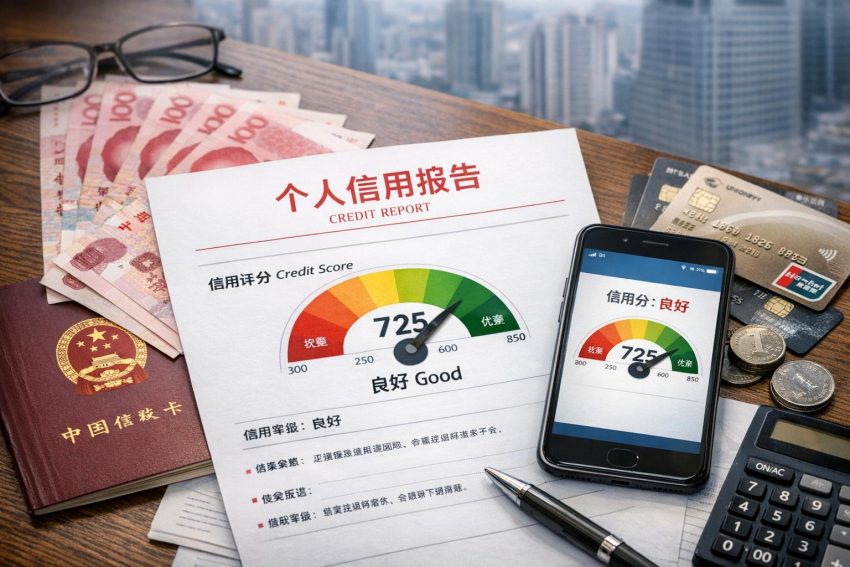
Personal credit in China rests mainly on a person’s credit report, repayment record, current debt, and financial profile. It does not rest on one government-issued number that follows every citizen through daily life. The phrase “Chinese credit score” is common in overseas reporting, but it often combines bank credit reporting, private scoring products, court enforcement records, and administrative programs that serve different purposes.
For bank loans, mortgages, credit cards, and many consumer finance products, the main record is the personal credit report maintained through the Credit Reference Center of the People’s Bank of China (PBOC). Banks read that report alongside income records, employment details, assets, debt obligations, and their own lending models. A private platform may calculate a separate score, though that number does not replace the PBOC report and does not bind every lender.
This distinction matters because a credit report is evidence, not a universal verdict. It can show how accounts were managed, but each lender still decides whether an applicant meets its requirements. Two banks can review the same borrower and reach different decisions without either bank misreading the report.
What personal credit means in China
In a financial setting, personal credit describes a person’s record of borrowing and meeting payment obligations. It covers loans, credit cards, guarantees, repayment dates, outstanding balances, account status, and related inquiries. It may also contain public information received through approved channels, including certain court enforcement records.
The Chinese term 征信, usually translated as credit reporting or credit information, refers to the collection, processing, storage, and supply of credit-related data. The PBOC Credit Reference Center, known as the 征信中心, runs the central financial credit information system used by banks and other participating institutions.
The central database should not be confused with a government rating system. It collects information submitted by reporting institutions and presents that material in a standardized report. The report may contain favorable, neutral, and adverse records. Opening a mortgage, holding a credit card, or having a personal loan does not by itself indicate poor credit.
A credit score is different. A score converts selected data into a number, band, or risk grade. A bank may calculate an internal score based on the PBOC report, account activity, salary deposits, occupation, age, assets, and application details. Another lender may assign different weights to the same facts. As a result, an applicant may qualify at one institution but fail the policy test at another.
Who regulates credit reporting
Personal credit reporting operates under national laws, administrative regulations, PBOC rules, and data-protection requirements. The Regulations on the Administration of the Credit Reporting Industry, effective since 2013, set out rules for collecting, storing, supplying, and correcting credit information. The Personal Information Protection Law, effective since 2021, also affects the handling of personal financial data.
These rules generally require a lawful basis for collecting and using personal information. Financial institutions must follow authorization, notification, security, and reporting duties applicable to the product and data involved. A lender cannot treat a customer’s full financial history as casual marketing material.
The legal framework also gives individuals rights connected with access and correction. A person may obtain their report, raise an objection to inaccurate data, and receive the result of an investigation. Those rights do not allow truthful adverse records to be erased on request, but they provide a process for correcting mistakes.
Licensed personal credit-reporting agencies may also operate outside the central PBOC reporting center. Baihang Credit and Pudao Credit are examples associated with commercial personal credit reporting. Their records and risk products can support lending decisions, particularly in areas involving online finance and non-bank data. They still do not create one mandatory national score for all personal activity.
What appears on a PBOC personal credit report
The contents depend on the accounts held by the person and the information submitted by participating institutions. A full report commonly includes identity data, account records, repayment status, inquiry history, and certain public records.
| Report section | Typical information | Why a lender reviews it |
|---|---|---|
| Identity details | Name, identity-document type and number, and other identifying data | Helps match the report to the correct applicant |
| Credit cards | Account status, credit limit, balance, repayment history, and overdue records | Shows management of revolving credit |
| Loans | Mortgages, consumer loans, business-related personal loans, and other reported borrowing | Shows debt exposure and payment conduct |
| Guarantees | Obligations arising from guarantees provided for another borrower | Identifies possible liabilities beyond the person’s own loans |
| Public records | Certain civil judgments, enforcement information, or administrative records received through lawful channels | May show unresolved legal or payment obligations |
| Inquiry history | Recent checks made by lenders and other authorized users | Shows recent applications and account-management activity |
The report may distinguish between active, closed, settled, transferred, written-off, or overdue accounts. Those labels have different meanings. A closed credit card with no unpaid balance is not the same as a loan written off after default. A settled overdue account is better than an unpaid one, though the earlier delay may remain visible during the lawful retention period.
Credit-card entries may show the granted limit, used balance, repayment condition, and past overdue months. Loan entries may show the original amount, current balance, repayment schedule, and account condition. The exact format may change as reporting standards and products are revised.
Some data can look unfamiliar even when it is accurate. A consumer loan arranged through an app may appear under the name of the bank, trust company, consumer finance company, or other institution that funded the loan. The brand shown to the customer is not always the legal lender shown on the report.
Positive, neutral, and adverse information
Not every entry is positive or negative. The existence of an account is often neutral. Regular payments create useful repayment history, while overdue payments create adverse history. A closed account can still provide evidence of past conduct.
A person with no reported borrowing may have a thin file or no usable credit history. This condition is sometimes described informally as a “white credit record.” It does not mean bad credit. It means the lender has less past repayment data to assess. The lender may then rely more heavily on salary, occupation, assets, banking activity, down payment, or a guarantor.
China does not have one universal personal credit score
There is no single public score that automatically determines whether a person can obtain a job, rent a home, buy a train ticket, receive medical care, or open a bank account. Financial institutions rely heavily on credit reports, but they apply their own policies and risk models.
A bank might produce an internal score that customers never see. It may examine repayment history, debt-to-income measures, the number of open accounts, recent applications, customer tenure, salary deposits, collateral, and loan purpose. Another bank may use a different model or place the applicant in a manual review process.
Private services may display consumer scores in mobile applications. Sesame Credit, associated with Ant Group, is the best-known example outside China. It was developed as a commercial scoring product connected with platform activity and partner services. It was not the PBOC credit report and never served as a compulsory government score for every citizen.
A platform score may affect deposit waivers, payment services, product eligibility, or risk checks within participating businesses. Its meaning remains tied to the company that created it. A score of 700 in one application cannot be treated as equal to 700 in another model because the data, scale, and intended use may differ.
How Chinese banks assess borrowers
Credit history is only one part of underwriting. Banks also ask whether the applicant has enough stable income to repay, whether existing obligations leave room for another payment, and whether the proposed loan complies with current banking and property rules.
For a mortgage application, the lender commonly reviews:
- The applicant’s PBOC credit report and repayment history;
- Salary, employment, tax, or business-income evidence;
- Existing mortgages, credit-card balances, and consumer loans;
- The down payment and source of funds;
- The property’s value, status, and eligibility for financing;
- Local purchase restrictions and current mortgage policy;
- The applicant’s age, loan term, and repayment capacity.
Consumer loans place more weight on unsecured debt, recent borrowing, employer and income stability, and the purpose of the funds. Credit-card applications may consider the applicant’s relationship with the bank, salary deposits, occupation, existing card limits, and past use of revolving credit.
A clean report does not guarantee approval. Someone with no missed payments may still be rejected because income is too low, debt is too high, documentation is incomplete, or the loan falls outside the bank’s policy. Conversely, an old minor delay does not always cause automatic rejection if the rest of the file is sound.
Debt burden and repayment capacity
Lenders assess whether monthly income can support current and proposed payments. The calculation may include mortgages, installment loans, card balances, guarantees, and other obligations. Banks do not publish one national debt-to-income threshold applying to every product and borrower.
High debt can cause concern even if every payment is current. A customer may have kept up so far but have little room to absorb a fall in income or an unexpected expense. Banks tend to prefer a borrower who has a manageable repayment burden rather than one using nearly every available credit line.
Guarantees deserve attention as well. A person who guarantees another borrower’s loan may become liable if that borrower defaults. A lender reviewing a new application may treat the guarantee as a possible financial obligation.
Recent credit inquiries
The report can show inquiries made by authorized institutions. The reason for an inquiry matters. A check connected with a new loan or credit-card application may be viewed differently from an account-management inquiry made by an existing lender.
Several applications within a short period can suggest that a person is trying to obtain funds from several lenders at once. That pattern does not prove financial distress, but it may prompt extra checks. Some borrowers submit applications through several loan apps without realizing that each request may lead to an inquiry.
Checking one’s own report is not the same as applying for a new loan. Personal access serves a review purpose and should not be interpreted as new borrowing. Even so, repeatedly ordering reports is rarely necessary unless the person is monitoring a correction, suspected fraud, or an upcoming application.
Late payments, arrears, and defaults
A payment becomes overdue when the borrower fails to meet the contractual payment requirement by the due date. Whether and how it appears on a report depends on the account, reporting cycle, contract, and institution’s reporting duties.
A short delay and a long-running default are not treated alike. Banks consider the amount, duration, frequency, reason, and later account conduct. One small delay caused by a failed automatic debit may receive a different response from repeated missed mortgage payments. There is no public formula forcing every bank to make the same decision.
Paying an overdue amount does not rewrite history as though the delay never happened. The account may be updated from unpaid to settled, but the previous status may remain visible for the applicable retention period. Settlement still matters because it stops the balance from remaining overdue and can reduce the risk of collection action, added charges, or litigation.
Automatic payment failures
Automatic repayment can reduce forgotten due dates, but it is not foolproof. The linked account may lack funds, the transfer limit may be too low, or the borrower may deposit money after the bank’s cut-off time. A payment instruction can also fail after a card replacement or account restriction.
Borrowers should check the repayment account before the due date and confirm that the debit completed. Keeping a small buffer is sensible. Relying on a last-minute transfer is a bit like arriving at the station as the doors close: occasionally it works, but it is not a sound routine.
Loan restructuring and settlement
If a borrower faces repayment difficulty, contacting the lender early is usually better than ignoring collection calls. A bank or finance company may offer restructuring, revised installments, or another arrangement where policy and law permit. Any arrangement should be documented in writing.
A negotiated payment does not always remove an adverse record. The report should reflect the actual status reported by the institution. Borrowers should ask how the account will be described, when updates will be submitted, and whether further interest or fees remain due.
How long adverse information remains
Chinese credit-reporting regulations commonly apply a five-year retention period to adverse personal information. Under the governing rule, the period generally runs from the termination of the adverse conduct or event. After the retention period expires, the credit-reporting institution should delete the covered adverse information.
The phrase termination of the adverse conduct or event matters. If a debt remains unpaid, a borrower should not assume that the five-year clock started on the date of the first missed installment. Repayment, settlement, account status, and the nature of the record can affect when the relevant period begins.
Not every record follows exactly the same treatment. Court enforcement data, ordinary loan arrears, administrative records, and lender account files may be governed by different procedures. The account itself may also remain listed after an adverse payment entry ages out, particularly if the account is still open.
During the retention period, an individual may have the right to provide an explanatory statement concerning adverse information. Such a statement does not force a lender to approve an application, but it can place the person’s account of the event on record. Anyone considering this option should use factual wording and retain evidence supporting the explanation.
Credit reporting and court enforcement are separate
An overdue bank payment and a court enforcement listing are not the same event. Ordinary arrears arise from a missed contractual payment. Court enforcement generally follows legal proceedings and an enforceable judgment or order.
A person who has the ability to comply with an effective legal judgment but refuses to do so may be placed on the list of dishonest persons subject to enforcement, known as 失信被执行人. Courts administer this process rather than banks using an ordinary credit-scoring model.
Restrictions can apply to certain high-consumption activities under court enforcement rules. Depending on the case and current law, they may affect forms of premium travel, high-cost consumption, or other activities covered by an enforcement order. These restrictions do not result from falling below a national score threshold.
Removal from an enforcement list follows judicial procedures. Paying or performing the obligation, reaching an approved settlement, correcting an erroneous listing, or meeting another legal condition may lead to removal. The person should deal with the responsible court rather than paying an online “credit repair” agent.
Financial credit and the social credit system
The term social credit system is often used as shorthand for several separate programs. That shorthand creates confusion. China has financial credit reporting, court enforcement records, corporate regulatory files, sector-based compliance records, and local administrative projects. They do not operate as one personal score shared by every bank, employer, landlord, and government office.
Financial credit reporting concentrates on borrowing, repayment, guarantees, inquiries, and related financial data. Court systems record compliance with judgments. Corporate credit files concern companies and business operators. Administrative agencies may maintain records linked to licensing, tax, market conduct, transport, or professional regulation.
Some data may be shared where law and policy permit, but shared data does not turn all databases into one score. The responsible agency, legal basis, data source, and consequence must be identified before any record can be interpreted properly.
Media reports sometimes connect a missed credit-card payment directly with travel restrictions. That skips several legal steps. A normal overdue payment can harm a borrower’s financial report and may lead to collection or litigation. Travel or high-consumption restrictions generally arise only after court proceedings and enforcement conditions are met.
How to obtain a personal credit report
Individuals can request their own credit information through authorized channels. Options may include the official PBOC Credit Reference Center service, designated bank channels, local inquiry counters, or approved self-service machines. Availability differs by location and can change as access methods are updated.
Identity verification is required. Chinese citizens commonly use a resident identity card. Foreign nationals and residents of Hong Kong, Macao, or Taiwan may need an accepted travel or residence document and may have to use an offline channel if online verification does not support their document type.
Under credit-reporting regulations, individuals can obtain their own credit report free of charge twice each year. Charges may apply to later requests under the applicable fee rules. Local procedures and delivery times should be checked through an authorized channel.
The report obtained online may be a summary version, while an offline inquiry can provide a more detailed record. A borrower preparing for a large loan may benefit from requesting the version that shows enough account and inquiry detail to detect errors.
What to check on the report
Start with identity data. A wrong document number, old passport, incorrect name format, or duplicate identity record can lead to missing or mismatched accounts. Then compare every credit account with personal records.
- Confirm that each loan and credit card belongs to you.
- Check whether closed accounts are marked correctly.
- Compare balances and repayment status with bank statements.
- Review overdue entries and the months to which they relate.
- Look for unfamiliar lender inquiries.
- Check guarantees and public records for accuracy.
An unfamiliar lender name is not always fraud. The institution shown may have funded a product sold under another brand. The borrower should compare contract documents, text messages, app records, and bank transfers before reaching that judgment.
If an account truly is unknown, the person should contact the reporting institution promptly, preserve a copy of the report, review bank and phone security, and consider reporting suspected identity misuse to the relevant authorities.
Correcting errors in a Chinese credit report
An individual who finds inaccurate or incomplete information can raise an objection with the credit-reporting institution or the organization that supplied the data. The request should identify the disputed entry and explain the claimed error in plain, factual language.
Useful evidence can include repayment receipts, bank statements, loan settlement letters, account-closure confirmations, identity documents, contracts, court papers, and written communication with the lender. Screenshots can help, though original statements or documents issued by the institution usually carry more weight.
Under the credit-reporting regulations, the institution handling an objection generally has 20 days from receipt to verify the matter and provide a written response. The disputed entry should be marked during the verification process. Practical timing may depend on complete identification and supporting documents.
If the provider confirms an error, it should correct the data supplied to the credit-reporting system. The individual should obtain a fresh report after the update cycle and verify that the correction appears. A verbal assurance from a call-center employee is useful, but written confirmation is better.
Errors versus accurate adverse records
A correction process deals with false, duplicated, outdated, or incomplete information. It does not provide a route for deleting a truthful missed payment simply because the entry causes a loan rejection.
Common correction cases include:
- A loan remains marked open after full settlement;
- A payment made on time is recorded as overdue;
- An account belongs to another person with similar identity data;
- A renewed passport causes the same customer to appear under separate records;
- A lender reports the wrong balance or account condition.
By contrast, a truthful overdue record normally remains for the lawful period. The borrower can repay the debt, maintain later accounts well, and provide an explanation where the rules allow, but cannot demand deletion solely because the record is inconvenient.
Credit repair scams and false promises
Businesses may claim they can “wash” a credit report, erase overdue entries, or create a new identity file. Many such claims are false. Some operators charge advance fees and disappear. Others ask customers to submit fabricated complaints, false police reports, or forged medical documents.
False evidence can create civil, administrative, or criminal risk. It may also expose identity documents, facial-recognition data, phone numbers, bank details, and verification codes to fraud. A company asking for an online-banking password or SMS code should be treated with caution.
Legitimate assistance is narrower. A lawyer or authorized adviser may help organize a genuine objection, communicate with a lender, or deal with court proceedings. They cannot lawfully force deletion of accurate data. The safest route is usually direct contact with the reporting institution and the lender named on the report.
Personal credit for foreign nationals
Foreign nationals can develop Chinese credit records when they borrow from participating institutions or hold reportable credit products. A foreign passport, permanent residence identity card, or another accepted document may be used, depending on the bank and product.
Document continuity can cause problems. Passport numbers often change at renewal, and name order or spacing may differ between banking systems. One bank might record the surname first, while another uses the order printed in the machine-readable zone. These differences can cause fragmented records or failed identity matching.
A foreign resident who renews a passport should update banks, card issuers, loan providers, mobile providers, tax records, and other relevant accounts. Keeping the old passport and renewal evidence can help connect the two document numbers.
Loan and credit-card applications may require a passport, valid residence permit, employment contract, salary records, tax documents, proof of address, and evidence of local banking history. Some institutions require a minimum period of residence or employment. Requirements vary by bank, city, product, and applicant status.
Overseas credit files are not automatically imported into the PBOC system. A strong credit record in another country may help only if a Chinese lender accepts foreign bank statements or reference letters as supporting evidence. Chinese credit information is also not routinely transferred into a foreign bureau file simply because the person moves abroad.
Hong Kong, Macao, and Taiwan residents
Residents of Hong Kong, Macao, and Taiwan may use accepted mainland travel, residence, or identity documents under the bank’s current procedures. Online systems do not always support every document type, so an in-person application may be needed.
As with foreign passport holders, consistent name and document records matter. Updating an expired permit promptly can prevent mismatches between older accounts and a new application.
Building a sound credit history
A sound record develops through ordinary account management rather than tricks. Borrowers should make payments before the due date, keep enough money in repayment accounts, read statements, and update contact details after changing a phone number or address.
Using credit responsibly can create repayment history, but taking unnecessary loans solely to build a record can be costly. Interest, fees, and the risk of missed payments may outweigh any benefit. A low-cost credit card paid in full can provide history for some customers, though approval is never guaranteed.
Borrowers should monitor total debt, not just each monthly installment. Several small loans can add up fast. Online products make borrowing convenient, and that convenience can hide the size of the combined obligation until a mortgage bank reviews the report.
Applications should also be paced sensibly. Sending the same request to many lenders may produce several inquiries and make the applicant appear short of funds. Comparing product terms before authorizing report checks is better than applying first and reading the conditions later.
Managing credit cards
Credit-card users should know the statement date, due date, minimum payment, installment terms, annual fee rules, and cash-advance charges. Paying only the minimum can prevent immediate delinquency under the contract, but it can leave a costly revolving balance.
Closing an unused card does not automatically improve the report. Before closure, the holder should repay all purchases, installments, interest, and fees. The bank should confirm closure, and a later report should show the correct account status.
Very high limits across several cards may affect a lender’s view even if balances are low, depending on its policy. On the other hand, cancelling an old account right before a mortgage application may create paperwork without providing a clear benefit. It is sensible to ask the mortgage bank what it requires before making changes.
Preparing for a mortgage or major loan
Several months before applying, obtain a report and correct errors. Avoid unnecessary consumer borrowing, keep card balances manageable, and prepare income and tax records. If any account was overdue, obtain settlement evidence and check that the report has been updated.
Do not open several “buy now, pay later” or app-based loan accounts just before applying. Even small balances may require explanation, and recent inquiries can lead the bank to ask whether more borrowing is pending.
Applicants with variable business income should keep clear bank records, contracts, tax filings, and financial statements where applicable. Cash income that cannot be documented may receive little weight in underwriting.
Privacy, consent, and safe report handling
A credit report contains sensitive personal and financial data. It should be stored securely and shared only where there is a valid reason. Sending an unredacted report through public messaging groups or leaving a printed copy with an unverified broker creates avoidable risk.
Before authorizing a credit check, read the consent wording and identify the institution requesting access. Some loan-comparison platforms send an application to more than one lender, which can result in several inquiries. The customer should know whether the platform is making a quotation or submitting a formal credit application.
Employers and landlords do not have unrestricted access to the central personal credit database. Access must follow applicable law and authorization rules. A request for a screenshot supplied by the individual is different from direct institutional access, though the individual should still consider whether the request is lawful and proportionate.
If a phone containing finance apps is lost, the owner should secure the mobile number, banking services, payment accounts, and identity-verification tools promptly. Credit monitoring can help detect unauthorized applications after identity theft.
Reading personal credit information in context
A Chinese personal credit report records financial relationships; it does not assign a complete measure of personal character. Banks use it to answer practical questions: What has the person borrowed? Were payments made as agreed? How much debt remains? Has the applicant recently requested more credit?
The PBOC report carries substantial weight in mainstream lending, yet approval still depends on the lender’s policy and the applicant’s finances. Private scores, platform grades, court records, and administrative files have their own functions and should not be treated as interchangeable.
Anyone concerned about their credit position should obtain an official report, verify the accounts, correct factual errors, repay outstanding obligations, and keep supporting records. That approach is less dramatic than paying a self-described credit fixer, but it is far more reliable.